



What's Happening?
NASA is conducting a series of explosive tests at Eglin Air Force Base in Florida to gather data on the explosive yield of liquid oxygen and methane-propelled rockets. This initiative is part of a tri-agency effort involving NASA, the Federal Aviation
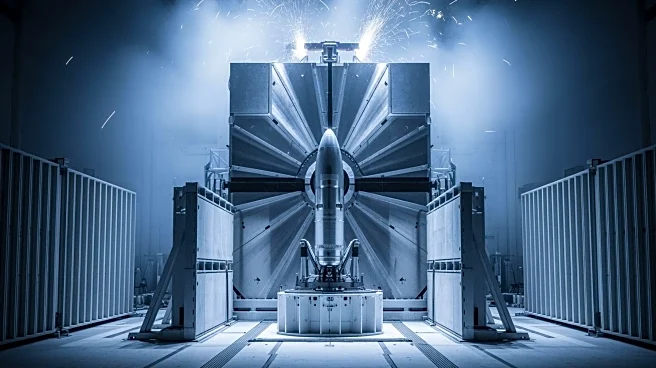
Administration, and the United States Space Force. The tests aim to develop safety protocols for future rocket launches. Engineers are using test articles that model fuel storage tanks with liquid oxygen and methane, separated by a common bulkhead. The tests simulate catastrophic failure scenarios by intentionally rupturing the barrier between the propellants. Instruments measure the intensity of the blast wave, and high-speed cameras capture thermal aspects and fragment travel. The data collected will help shape safety requirements and launch site planning for methane-based propulsion systems.
Why It's Important?
The tests are crucial for ensuring the safety of future rocket launches, especially as commercial launch providers advance propulsion technology. By understanding the explosive potential of liquid oxygen and methane, NASA can develop more robust safety protocols, reducing risks associated with rocket launches. This is particularly important as the space industry grows and more rockets are launched. The findings will benefit government and industry stakeholders by providing critical data to enhance public and site safety. The collaboration between NASA, the FAA, and the Space Force underscores the importance of inter-agency cooperation in addressing complex safety challenges in space exploration.
What's Next?
The test series will continue with larger test articles, scaling up to 20,000 pounds of propellants by June. These tests will simulate different failure configurations to gather comprehensive data on explosion hazards. The results will inform future safety protocols and launch site planning. As the tests progress, NASA will refine its safety measures, potentially influencing regulations and standards for commercial spaceflight. The data could also lead to innovations in rocket design and fuel storage, enhancing the overall safety and efficiency of space missions.