
What's Happening?
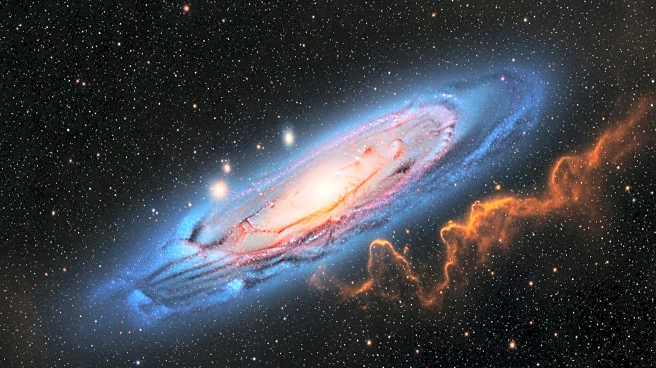
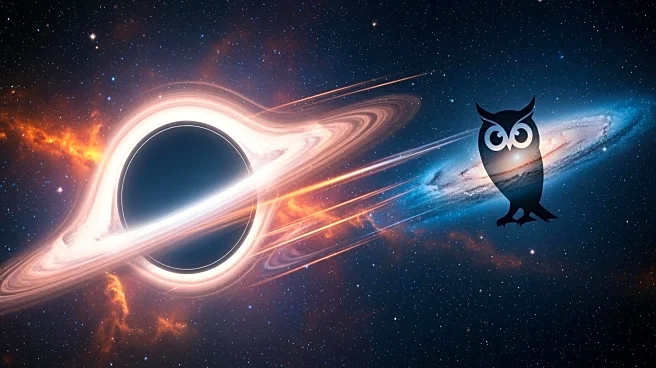
Astronomers have confirmed the first known case of a runaway supermassive black hole (SMBH) in the Cosmic Owl galaxy, located approximately 8.8 billion light-years away. This discovery was made possible
through observations by the James Webb Space Telescope (JWST) and the Hubble Space Telescope (HST). The runaway SMBH was identified by its distinctive tail, which is about 200,000 light-years long, and a supersonic bow shock. These features suggest that the black hole was ejected from its host galaxy due to gravitational interactions, possibly involving a three-body interaction or gravitational wave recoil from a black hole merger. The research, led by Pieter van Dokkum from Yale University, provides strong evidence supporting the theoretical prediction that SMBHs can escape their galaxies.
Why It's Important?
The confirmation of a runaway supermassive black hole has significant implications for our understanding of galaxy dynamics and the evolution of the universe. It supports long-standing theoretical predictions about the behavior of SMBHs during galaxy mergers. This discovery also highlights the capabilities of the JWST in observing distant cosmic phenomena, potentially leading to more discoveries of similar runaway black holes. Understanding these events can provide insights into the processes that shape galaxies and the role of SMBHs in cosmic evolution. The presence of such massive objects moving through space could also influence the formation of new stars and the distribution of matter in the universe.
What's Next?
Future research will likely focus on identifying more runaway supermassive black holes using upcoming wide-field surveys with telescopes like Euclid and the Nancy Grace Roman Space Telescope. These surveys could provide a systematic way to detect similar features in other galaxies, enhancing our understanding of the frequency and impact of such events. Additionally, continued observations with the JWST and HST will help refine models of SMBH dynamics and their interactions with surrounding matter. The discovery opens new avenues for studying the consequences of galaxy mergers and the mechanisms driving SMBH ejections.