
What's Happening?
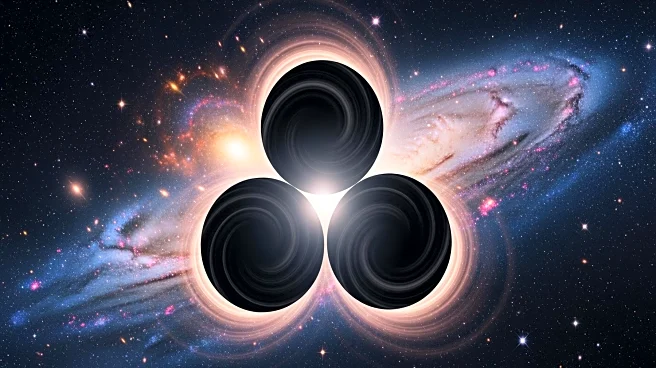
Astronomers have identified a rare cosmic event where three supermassive black holes are merging into one. This phenomenon is occurring as three galaxies, each with a supermassive black hole at its center,
are in the process of merging into a single, larger galaxy. The discovery was made by Emma Schwartzman and her team at the US Naval Research Laboratory in Washington DC. The black holes are actively feeding and emitting low-frequency radio waves, which allowed the team to observe them using the Very Long Baseline Array in Hawaii and the Very Large Array in New Mexico. This event is significant because such mergers are typically short-lived and difficult to detect, with only about 150 pairs of merging galactic black holes observed previously.
Why It's Important?
The observation of three supermassive black holes merging is a significant milestone in understanding the dynamics of galaxy formation and the growth of black holes. These mergers are believed to be a crucial part of how supermassive black holes grow to their enormous sizes. The event provides a unique opportunity for astronomers to study the complex physics involved in such mergers, which are rarely observed. Understanding these processes can offer insights into the evolution of galaxies and the role of black holes in shaping the universe. The findings could also help refine models of galaxy formation and the behavior of black holes during such cosmic events.
What's Next?
As the galaxies continue to merge, astronomers will have the opportunity to study the interactions and eventual unification of the black holes in greater detail. This could lead to new discoveries about the behavior of black holes and the gravitational forces at play during such mergers. The ongoing observations may also provide data to improve simulations of galaxy mergers, enhancing our understanding of these complex cosmic phenomena. Researchers will likely continue to monitor the system to capture more data as the merger progresses.
Beyond the Headlines
The merging of three supermassive black holes presents an opportunity to explore the less obvious implications of such cosmic events. It raises questions about the long-term stability of the resulting galaxy and the potential for new star formation triggered by the merger. Additionally, the event highlights the importance of advanced observational technologies in uncovering rare astronomical phenomena. The study of this merger could also contribute to the broader understanding of gravitational waves, as such massive interactions are potential sources of these ripples in spacetime.