



What's Happening?
A viral video depicting a heated parking dispute near Huston-Tillotson University in East Austin has led to protests outside a local home. The video, posted last week by Huston-Tillotson student Bri, shows a couple living on E 9th Street confronting students
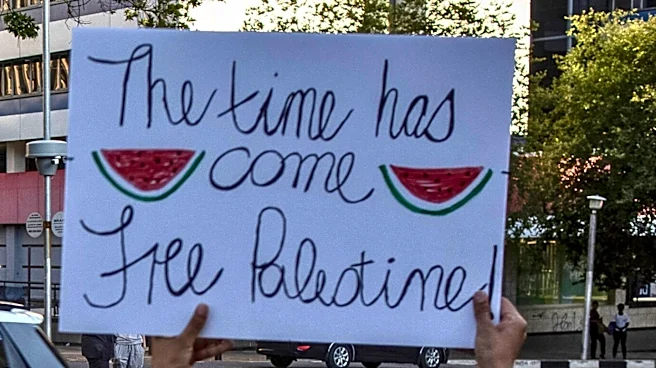
about parking in front of their house. In the video, the woman from the couple makes comments about the university's graduation rates and asserts ownership over the neighborhood, stating, 'We paid $1.5 million for our house, y'all's graduation rates are 25%.' Bri, the student, countered by pointing out that the neighborhood is historically Black. Neighbors, including Sybill Bradley who has lived on E 9th Street for 16 years, confirmed that students parking on the street has been a long-standing norm without significant issues. The City of Austin's Transportation and Public Works department clarified that parking is indeed allowed on those blocks of East 9th Street, except for specific areas like driveways and intersections. Following the video's virality, crowds of students and community members gathered outside the couple's home over the weekend, playing music, chanting, and displaying signs, with police present to ensure peaceful interactions.
Why It's Important?
This incident highlights significant tensions surrounding gentrification, community identity, and public space in historically Black neighborhoods. The woman's comments about property value and the university's graduation rates, coupled with her assertion of 'our neighborhood,' are perceived by many as dismissive and disrespectful towards the long-standing community and its institutions. For Huston-Tillotson University students and residents of East Austin, the dispute transcends a simple parking issue, touching upon themes of racial insensitivity, economic disparity, and the displacement of original residents. The protests demonstrate the community's collective response to perceived injustice and their determination to protect their cultural heritage and sense of belonging. The City of Austin's clarification on parking regulations validates the students' right to park on the public street, further underscoring the homeowner's unfounded claims and potentially escalating the social implications of the dispute. This event serves as a microcosm of broader societal challenges related to urban development and cultural preservation.
What's Next?
The protests outside the home are likely to continue as community members and students seek to make their voices heard and challenge what they perceive as discriminatory behavior. The viral nature of the video ensures continued public attention, which could lead to further dialogue or action from local authorities and community leaders. The homeowner, who declined to comment to FOX 7, is now facing public scrutiny and the consequences of her remarks. This situation may prompt Huston-Tillotson University to engage more formally with the surrounding community to address parking concerns and foster better town-gown relations. Furthermore, the incident could catalyze broader discussions within Austin about gentrification's impact on historically marginalized communities and the need for policies that protect existing residents and cultural institutions. The ongoing police presence at the protests suggests a continued need for mediation and ensuring public safety as the community expresses its grievances.
Beyond the Headlines
The parking dispute in East Austin reveals deeper societal issues beyond mere property rights, touching upon the complex dynamics of race, class, and urban development. The homeowner's reference to her property value and the university's graduation rates exposes underlying biases and a sense of entitlement that can emerge with gentrification. This incident underscores how seemingly minor conflicts can quickly escalate into significant social movements when they tap into historical grievances and systemic inequalities. It highlights the importance of preserving the cultural fabric of historically Black neighborhoods and the challenges faced by institutions like Huston-Tillotson University in maintaining their community ties amidst rapid urban change. The protests serve as a powerful reminder that public spaces, even street parking, can become battlegrounds for identity and belonging, reflecting broader struggles over who has the right to define and inhabit a community. This event could inspire similar community actions in other cities grappling with gentrification and its social consequences.