
What's Happening?
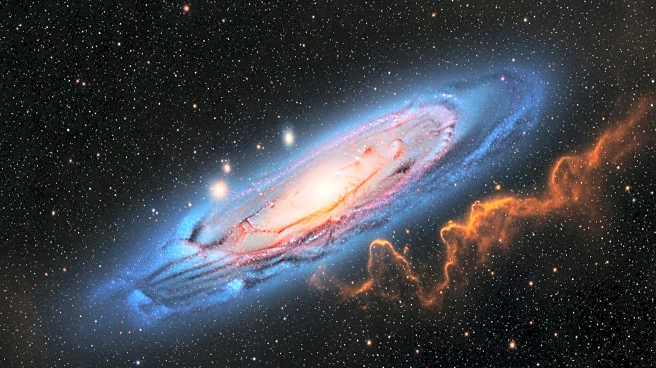
The James Webb Space Telescope (JWST) has made a significant discovery in the dwarf galaxy Sextans A, revealing the presence of polycyclic aromatic hydrocarbons (PAHs) and rare dust types, including metallic
iron and silicon carbide. These findings are notable because Sextans A is one of the most chemically primitive galaxies near the Milky Way, containing only 3 to 7 percent of the Sun's metal content. The discovery suggests that even in environments with low metallicity, stars and interstellar mediums can still produce solid dust grains. This research, led by Elizabeth Tarantino and Martha Boyer from the Space Telescope Science Institute, provides new insights into how early galaxies evolved and developed the building blocks for planets.
Why It's Important?
This discovery is crucial for understanding the early universe's conditions and the formation of galaxies. The presence of PAHs and rare dust types in a low-metallicity environment like Sextans A challenges previous assumptions about dust production in the early universe. It suggests that stars could create the building blocks of planets even when typical ingredients were scarce. This finding has implications for interpreting the most distant galaxies imaged by JWST and understanding the universe's evolution. It highlights the diverse pathways for dust production beyond the established methods like supernova explosions, offering a new perspective on cosmic history.
What's Next?
The research team plans to further study the detailed chemistry of Sextans A's PAH clumps using high-resolution spectroscopy in an approved Webb Cycle 4 program. This continued research will help unravel the complexities of dust formation in the early universe and refine our understanding of galactic evolution. The findings could influence future astronomical studies and models, providing a more comprehensive picture of how galaxies and planetary systems form under varying conditions.
Beyond the Headlines
The discovery underscores the ingenuity of the early universe in creating complex structures with limited resources. It challenges the notion that high metallicity is necessary for dust production, suggesting that early stars found alternative methods to produce essential materials. This could lead to a reevaluation of how we understand the formation of planets and galaxies, potentially impacting theories about the origins of life and the conditions necessary for its development.