



What's Happening?
The IceCube Neutrino Observatory, located two and a half kilometers beneath the Antarctic ice, is actively detecting neutrinos originating from black holes and other violent cosmic events. This unique observatory consists of 5,160 light sensors embedded
in a cubic kilometer of frozen water. Unlike traditional telescopes, IceCube uses the Earth itself as a filter. Muons, which are heavier cousins of electrons and a significant source of noise, cannot penetrate the planet, while neutrinos can. This allows IceCube to focus on neutrinos that have traveled through the Earth, providing a clear view of the northern hemisphere's sky from the South Pole. The sensors detect faint blue flashes produced when a neutrino interacts with an atomic nucleus within the ice, allowing physicists to determine the neutrino's origin and energy. The observatory has been operational since 2004, with an upgrade completed in January to enhance its detection capabilities for lower-energy neutrinos and improve ice measurement precision.
Why It's Important?
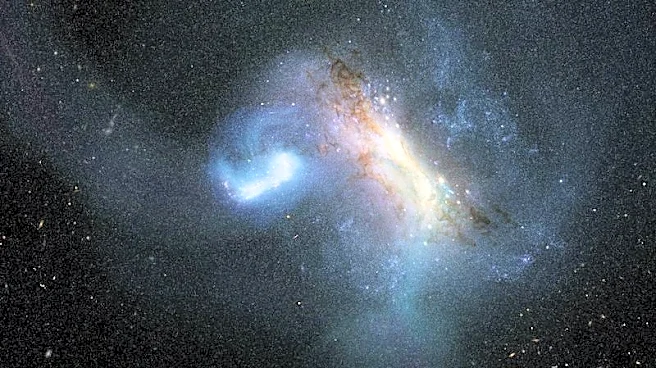
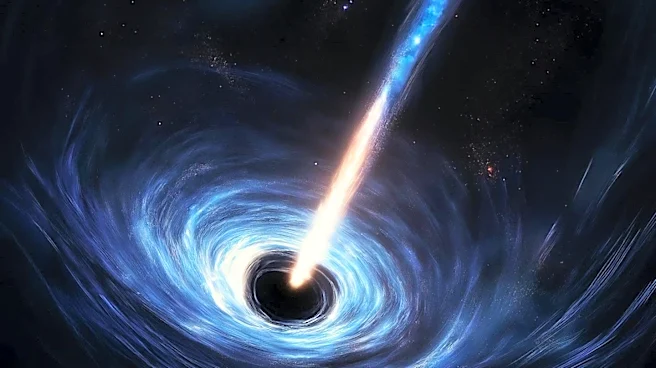
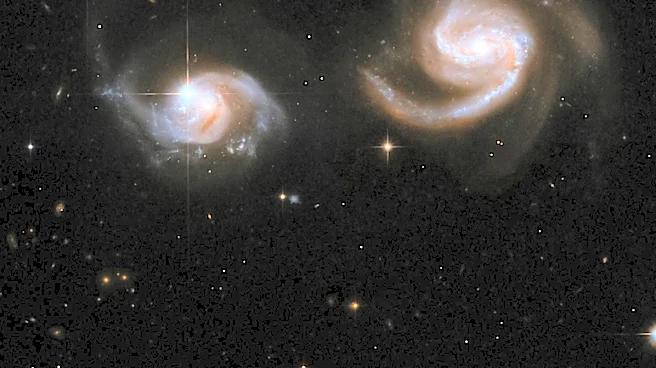
The work conducted by IceCube is crucial for advancing our understanding of the universe's most energetic phenomena, including black holes, exploding stars, and colliding galaxies. Neutrinos, due to their minimal interaction with matter, act as pristine messengers from distant cosmic sources, providing information that light cannot. By studying these particles, scientists can gain insights into the processes occurring in the hearts of black holes and other extreme environments. The ability to trace neutrinos back to specific cosmic objects, as demonstrated by the 2017 and 2022 findings, marks a significant step in multi-messenger astronomy. This research contributes to a more complete picture of cosmic evolution and the fundamental forces governing the universe, potentially revealing new physics beyond current models.
What's Next?
The IceCube collaboration continues to analyze data, with recent reports indicating a kink in the energy spectrum of cosmic neutrinos, suggesting multiple types of sources. They have also published evidence linking neutrinos to X-ray-bright active galaxies in the southern sky. The recent upgrade, which involved installing over 600 modern sensors, aims to sharpen the detector's view of lower-energy neutrinos and allow for more accurate reanalysis of over a decade of old data. This upgrade is a precursor to a much larger planned expansion, IceCube-Gen2, which would increase the detector's size to approximately eight cubic kilometers and incorporate surface arrays and radio antennas. This future expansion is expected to enhance sensitivity to even higher-energy neutrinos, further broadening our understanding of the universe's most violent objects.
Beyond the Headlines
The innovative design of IceCube, utilizing a natural medium like Antarctic ice as its detector, represents a paradigm shift in astronomical observation. This approach highlights the potential for leveraging extreme natural environments for scientific research, pushing the boundaries of what is considered a 'telescope.' The project also underscores the collaborative nature of modern science, involving international teams and advanced engineering to overcome significant logistical and technical challenges in one of the planet's most remote locations. The insights gained from IceCube's neutrino detections could have profound implications for theoretical physics, potentially confirming or challenging existing models of particle physics and cosmology. The ability to 'see' through the Earth to observe the northern sky also offers a unique perspective, demonstrating how creative solutions can circumvent traditional observational limitations.