



What's Happening?
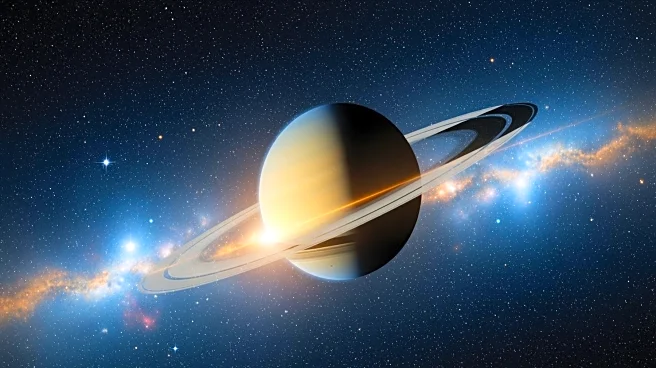
NASA has released the most detailed images of Saturn to date, captured by the James Webb Space Telescope and the Hubble Space Telescope. The Webb telescope's infrared capabilities have allowed scientists to observe Saturn's atmosphere in unprecedented
detail, revealing a long-lived jet stream known as the 'ribbon wave' across the planet's northern mid-latitudes. Meanwhile, Hubble's visible light imaging has highlighted subtle color variations across Saturn's surface. These observations provide new insights into the atmospheric dynamics and chemical composition of the gas giant, enhancing our understanding of its complex weather systems.
Why It's Important?
The new images of Saturn are significant for the scientific community as they offer a deeper understanding of the planet's atmospheric conditions and chemical makeup. This information is crucial for comparative planetology, helping scientists draw parallels between Saturn and other gas giants, including Jupiter. The data could also inform future missions to Saturn and its moons, potentially aiding in the search for extraterrestrial life. Moreover, the collaboration between the Webb and Hubble telescopes exemplifies the power of combining different observational technologies to advance space exploration.