


What's Happening?
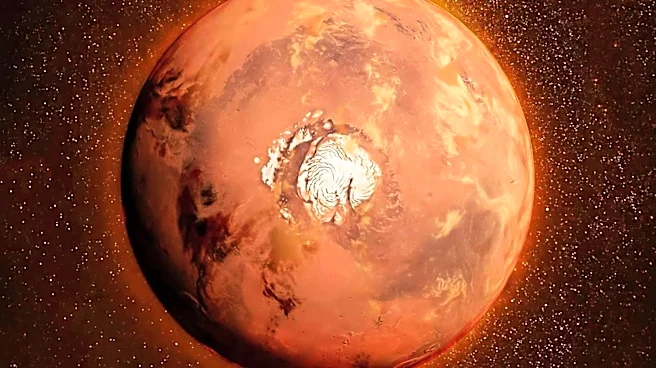
A Russian-led research team has presented new evidence suggesting that Mars may still harbor volcanic activity beneath its surface, despite the absence of observed eruptions. The study, published in Science Advances, focuses on repeated detections of hydrogen
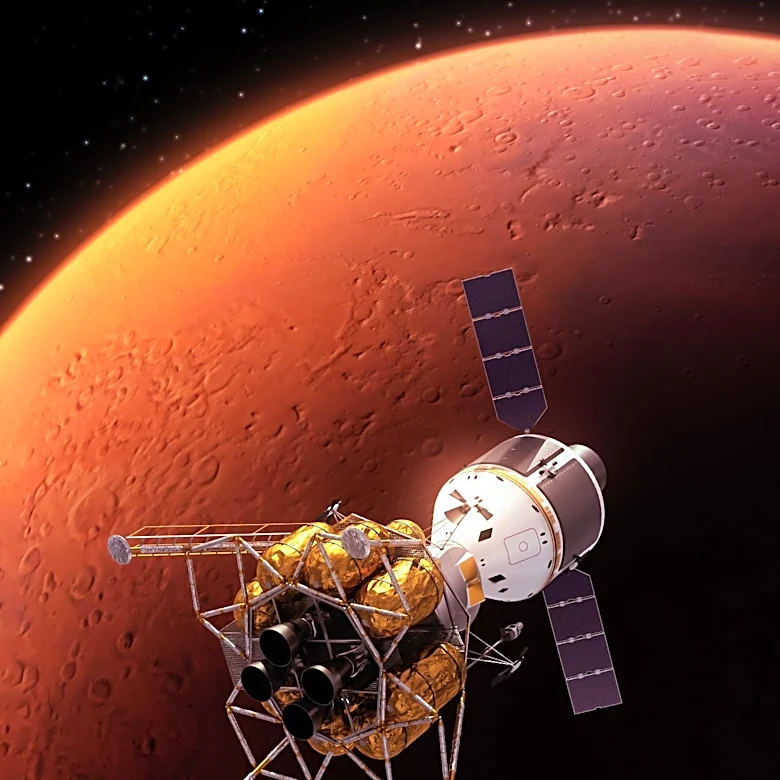
chloride (HCl) concentrated near Alba Mons, an ancient Martian volcano. The researchers propose that this gas could be seeping from underground magma chambers. The HCl was detected by the ExoMars Trace Gas Orbiter (TGO), a joint project between the European Space Agency and Russia's Roscosmos. The team, co-led by Aleksandr Trokhimovsky of the Space Research Institute of the Russian Academy of Sciences and Daniel Mege of the Polish Academy of Sciences, also identified recent, narrow fractures in the area, some less than a meter wide. These fissures are believed to provide pathways for volcanic gases to escape into the atmosphere. The study suggests that gas escaping from underground magma could become trapped beneath ice during colder months and then released as temperatures rise in early summer, explaining the observed seasonal spikes in HCl.
Why It's Important?
This research is significant because it challenges the long-held view that Mars is volcanically dead. If confirmed, ongoing volcanic activity would imply that Mars' interior is still hot enough to sustain magma, which has profound implications for the planet's geological evolution and potential for life. On Earth, volcanic activity often creates hydrothermal systems, which are considered prime environments for the emergence and sustenance of microbial life. The presence of active magma chambers could mean that similar warm, subsurface environments exist on Mars, shielded from the harsh surface conditions. This discovery could redirect the search for extraterrestrial life on Mars, focusing future missions and investigations on these newly identified fissures and potential hydrothermal systems. Understanding the planet's internal heat and geological processes is crucial for comprehending its past habitability and future potential.
What's Next?
The findings from this Russian-led study will likely prompt further investigation and analysis by the international scientific community. Future Mars missions, particularly those equipped with advanced atmospheric and subsurface probes, may prioritize studying the Alba Mons region and other ancient volcanic sites for similar gas emissions and geological features. Scientists will aim to confirm the magmatic origin of the hydrogen chloride and to assess the extent and nature of any ongoing volcanic activity. This could involve deploying more sensitive seismometers to detect 'marsquakes' indicative of magma movement or using ground-penetrating radar to map subsurface structures. The identification of potential hydrothermal systems would also guide the development of new astrobiological instruments designed to detect biosignatures in such environments. International collaborations, like the one between the European Space Agency and Roscosmos, will be crucial in advancing this research.
Beyond the Headlines
The potential for ongoing volcanic activity on Mars opens up a fascinating avenue for understanding planetary habitability beyond Earth. If Mars retains internal heat and active geological processes, it suggests a more dynamic and potentially life-sustaining planet than previously thought. This could influence our understanding of how planets evolve and retain conditions favorable for life over billions of years. Ethically, if subsurface life is discovered, it would raise profound questions about our place in the universe and the definition of life itself. Legally, any discovery of Martian life would necessitate international discussions on planetary protection protocols and the responsible exploration of extraterrestrial environments. Culturally, such a discovery would undoubtedly spark widespread public interest and could inspire a new era of space exploration focused on astrobiology and the search for life beyond Earth, fundamentally altering humanity's perspective on its cosmic neighborhood.