






What's Happening?
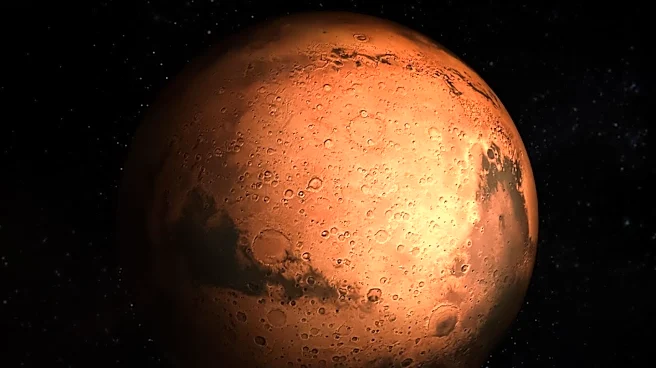
China is making significant progress on its Tianwen-3 Mars sample return mission, with a planned launch in 2028. The mission aims to collect approximately 500 grams of Martian samples and return them to Earth by 2031. The China National Space Administration
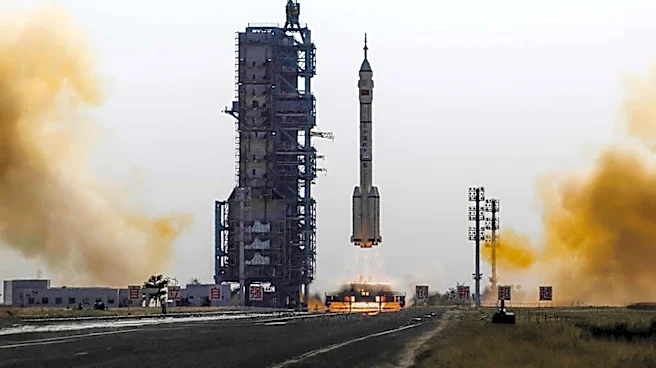
has outlined that the Tianwen-3 mission will comprise a lander, an ascender, a service capsule, an orbiter, and an Earth reentry module. Hou Zengqian, the mission's chief scientist, stated that the probe equipment has entered the prototype development phase, and scientific teams across China are actively addressing technical challenges and scientific objectives. The mission will launch on two Long March 5 heavy-lift rockets from the Wenchang Space Launch Site on Hainan island. A key scientific goal of Tianwen-3 is to search for microbial traces or other forms of life on Mars, and the mission expects to finalize its landing site by the end of 2026.
Why It's Important?
This mission holds substantial importance as it could represent a 'Sputnik moment' in space exploration, potentially positioning China as the first nation to successfully return Martian samples to Earth. Such an achievement would not only elevate China's standing in the global space race but also provide invaluable scientific data. The returned samples, regardless of whether they contain signs of life, will offer unprecedented insights into Mars' geology, environmental history, and the conditions necessary for life's emergence. This could significantly advance astrobiology and planetary science, influencing future research directions and potentially reshaping our understanding of life beyond Earth. The mission's focus on identifying biosignatures could lead to groundbreaking discoveries, impacting scientific communities worldwide and potentially inspiring new generations of scientists and engineers.
What's Next?
The Tianwen-3 mission is scheduled for launch in 2028, with the return of Martian samples to Earth anticipated around 2031. In the immediate future, Chinese specialists are working to finalize the mission's landing site by the end of 2026, concurrently advancing the development of a next-generation geological map of Mars. A 'planetary protection laboratory' is also being established in Hefei, China, to manage the returned Martian samples. This facility will implement a two-way protection system to safeguard both the samples and Earth's biosphere, focusing on sterilization, processing, and biological risk assessment. These steps are crucial for ensuring the integrity of the samples and preventing potential contamination, aligning with international planetary protection policies.
Beyond the Headlines
The Tianwen-3 mission carries profound implications beyond its immediate scientific objectives. If China succeeds in being the first to return Martian samples, especially if evidence of extraterrestrial life is found, it could trigger a significant shift in geopolitical dynamics and scientific leadership. This achievement would underscore China's growing technological prowess and strategic ambition in space, potentially influencing international collaborations and competition in space exploration. Ethically, the mission raises critical questions about planetary protection and the responsible handling of potential extraterrestrial biological material. The establishment of a dedicated planetary protection laboratory highlights the complex challenges and ethical considerations involved in bringing samples from another planet to Earth, emphasizing the need for stringent protocols to prevent both forward and backward contamination. The mission's success could also inspire a renewed global focus on astrobiology and the search for life beyond Earth, potentially leading to a re-evaluation of humanity's place in the cosmos.