



What's Happening?
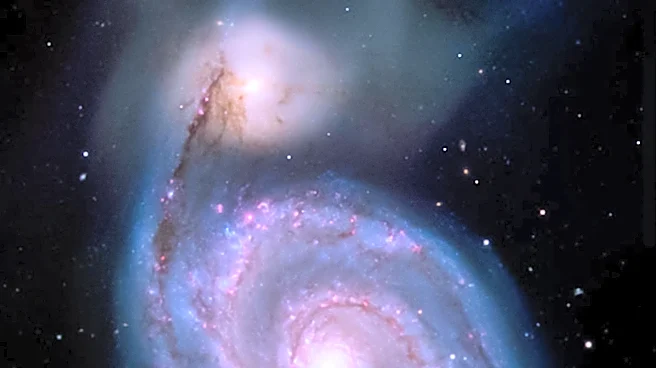
On October 13, 1773, French astronomer Charles Messier discovered what is now known as the Whirlpool Galaxy, or Messier 51 (M51). At the time of its discovery, Messier, whose primary role was to identify comets, cataloged M51 as the 51st 'comet-like object
to avoid' in the night sky. He was unable to discern its spiral structure and did not identify it as a galaxy. It was not until 72 years later that another astronomer, William Parsons, observed its whirlpool shape, though he mistakenly identified it as a spiral nebula. Eventually, Edwin Hubble's later work confirmed that M51 and similar celestial features were, in fact, galaxies. The Whirlpool Galaxy is located approximately 31 million light-years from Earth and is considered a textbook example of a spiral galaxy.
Why It's Important?
Messier's cataloging of M51, despite his initial misidentification, was a crucial step in the systematic observation and classification of deep-sky objects. His efforts to distinguish between comets and other celestial bodies laid foundational groundwork for future astronomical discoveries. The subsequent re-identification of M51 by Parsons and ultimately by Hubble highlights the progressive nature of scientific understanding, where initial observations are refined and reinterpreted with improved technology and theoretical frameworks. The Whirlpool Galaxy itself is significant as a prime example of a spiral galaxy, and its striking appearance, believed to be influenced by a close interaction with its neighbor galaxy NGC 5195, provides valuable insights into galactic evolution and star formation processes. This historical progression from a 'fuzzy blob' to a recognized galaxy underscores the continuous advancement of astronomical science.
What's Next?
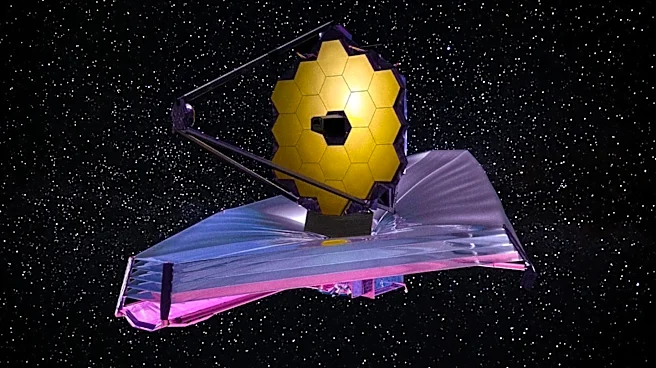
While the initial discovery and classification of the Whirlpool Galaxy are historical events, ongoing research continues to explore its dynamics. Scientists suspect that the galaxy's distinctive spiral shape and increased star formation are due to its gravitational interaction with NGC 5195, which may have passed through M51's main disk about 500 million years ago. Future studies will likely continue to use advanced telescopes, such as the Hubble Space Telescope, to observe and model these galactic interactions, providing further insights into how gravitational forces shape galaxies and trigger starbirth. The Whirlpool Galaxy remains a key object of study for understanding galactic mergers and their impact on cosmic structures.
Beyond the Headlines
The story of the Whirlpool Galaxy's discovery and subsequent re-classification reflects the iterative nature of scientific progress. It illustrates how early astronomers, limited by their technology, made crucial observations that paved the way for later, more accurate understandings. Messier's catalog, born out of a practical need to avoid confusion during comet hunting, inadvertently became a foundational list for deep-sky astronomy. The evolution of our understanding of M51, from a non-comet to a nebula, and finally to a galaxy, mirrors humanity's expanding cosmic perspective. It also highlights the role of technological advancements, like the Hubble Space Telescope, in revealing the intricate details of the universe that were once invisible, transforming our perception of celestial objects and their profound beauty.