


What's Happening?
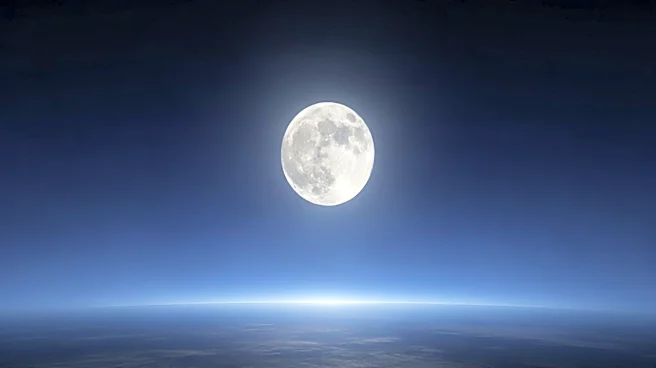
Live Science has published an article discussing the varying appearances of the moon from different locations on Earth. The article explains that the moon's appearance changes due to the observer's geographical location, with significant differences noted
between the Northern and Southern Hemispheres. For instance, the iconic Tycho crater appears at different positions on the moon's face depending on whether it is viewed from the North or South Pole. The article also highlights how the moon's phases and orientation can appear differently, influenced by the observer's latitude. This phenomenon is attributed to the moon's synchronous rotation and the observer's perspective relative to the moon's orbit.
Why It's Important?
This exploration of the moon's varying appearances is important for enhancing public understanding of basic astronomical concepts and the nature of celestial observations. It underscores the importance of perspective in astronomy, a field that relies heavily on observational data. For educators and science communicators, such insights are valuable for developing educational materials that accurately convey the complexities of lunar observations. Additionally, this knowledge can enrich the experience of amateur astronomers and enthusiasts, fostering a deeper appreciation for the dynamics of the Earth-moon system.