
What's Happening?
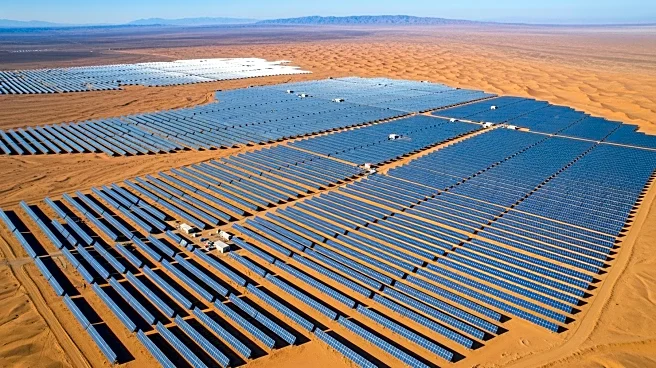
A recent study has focused on quantifying land-use metrics for solar photovoltaic (PV) projects in the Western United States. The research covers states within the Western Interconnection, including Arizona,
California, and others, using data from the U.S. Energy Information Administration (EIA) and aerial imagery from the National Agriculture Imagery Program (NAIP). The study employs deep learning technology to analyze land use, aiming to provide a more accurate depiction of land-use changes associated with solar PV installations. The research compares its findings with previous datasets from the U.S. Geological Survey (USGS) and the Lawrence Berkeley National Laboratory, highlighting differences in land-use estimates. The study also explores various annotation methods for solar PV panels, using a deep learning model to automate the segmentation of PV panels from aerial images.
Why It's Important?
This study is significant as it provides a detailed analysis of land-use changes due to solar PV projects, which is crucial for understanding the environmental impact of renewable energy installations. By using advanced deep learning techniques, the research offers more precise land-use metrics, which can inform policy decisions and improve the planning of future solar projects. The findings could influence how land is allocated for renewable energy, balancing the need for clean energy with environmental conservation. The study's methodology also sets a precedent for using technology in environmental assessments, potentially leading to more efficient and accurate evaluations in other regions and sectors.
What's Next?
The study's results could lead to further research and refinement of land-use metrics for solar projects, potentially influencing regulatory frameworks and land-use policies. Stakeholders, including policymakers, environmental groups, and the solar industry, may use these findings to advocate for more sustainable land-use practices. Additionally, the study's methodology could be applied to other renewable energy projects, enhancing the understanding of their environmental impacts. As solar energy continues to expand, ongoing research will be essential to ensure that growth is managed sustainably.
Beyond the Headlines
The study highlights the potential for deep learning and AI to transform environmental assessments, offering a more efficient and accurate approach to analyzing land use. This technological advancement could lead to broader applications in environmental science, improving the ability to monitor and manage natural resources. The research also underscores the importance of standardizing land-use metrics, which could facilitate better comparisons across studies and regions, ultimately leading to more informed policy decisions.