
What's Happening?
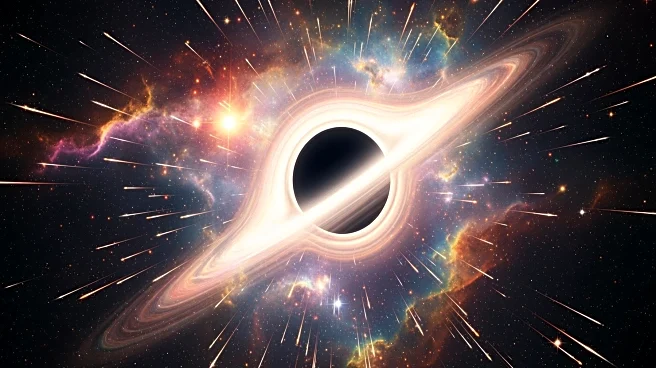
A black hole has shredded a massive star in a cosmic event known as a Tidal Disruption Event, observed by astronomers and reported at the American Astronomical Society's annual meeting. The event, designated AT2024wpp and nicknamed the Whippet, released
energy 400 billion times that of the sun, surpassing the most powerful known supernovae. The phenomenon was identified using the Zwicky Transient Facility and confirmed by observations from the Liverpool Telescope and NASA's Swift satellite. The event's extreme energy and characteristics suggest it is a Luminous Fast Blue Optical Transient (LFBOT), a rare type of visual event associated with star destruction.
Why It's Important?
This event provides new insights into the behavior of black holes and the dynamics of star destruction. It highlights the potential for black holes to produce some of the universe's most energetic phenomena, offering a unique opportunity to study the physics of these events. Understanding such occurrences can help scientists identify black holes, explore their formation and growth, and refine models of cosmic events. The findings also underscore the importance of continued observation and study of transient cosmic phenomena.
What's Next?
Further investigations into AT2024wpp will focus on the shock-wave produced by the event and its interaction with surrounding gas. Researchers aim to understand the event's full impact and the potential for similar occurrences in the future. The study of such events could lead to new discoveries about the nature of black holes and their role in the universe, potentially influencing future astronomical research and exploration.