




What's Happening?
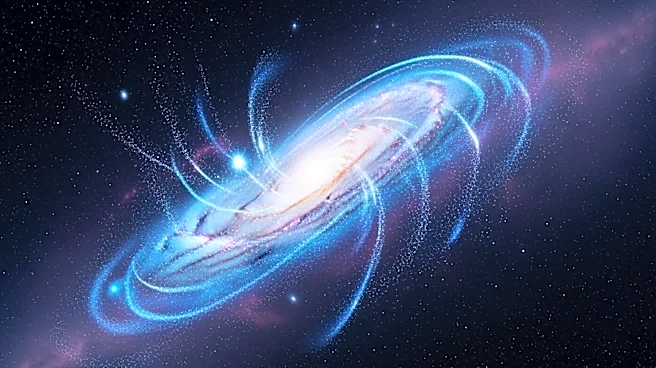
The James Webb Space Telescope (JWST) has provided new insights into the early universe by detecting a 'galaxy-killing wind' in a system of galaxies known as CRISTAL-02. This phenomenon, observed about 1 billion years after the Big Bang, involves immense
outflows of gas driven by intense winds from rapid star formation and supernova explosions. These winds are capable of quenching star formation by dispersing the cool molecular gas needed to form new stars. The study, published in the Monthly Notices of the Royal Astronomical Society, suggests that such winds could explain why many early massive galaxies stopped forming stars and became quiescent.
Why It's Important?
This discovery is significant as it provides a potential explanation for the rapid cessation of star formation in early massive galaxies, a long-standing enigma in cosmology. Understanding these processes is crucial for improving cosmological models and simulations that aim to explain the evolution of galaxies and the universe. The findings also suggest that similar processes could occur in the future when the Milky Way collides with the Andromeda galaxy, potentially leading to a similar quiescent state.
What's Next?
Future research will likely focus on further observations of similar galactic systems to confirm the prevalence and impact of these galaxy-killing winds. Additionally, astronomers may explore the role of black holes in driving such outflows, as previous simulations have suggested. These studies will help refine our understanding of galaxy evolution and the mechanisms that lead to the quiescence of massive galaxies.