
What's Happening?
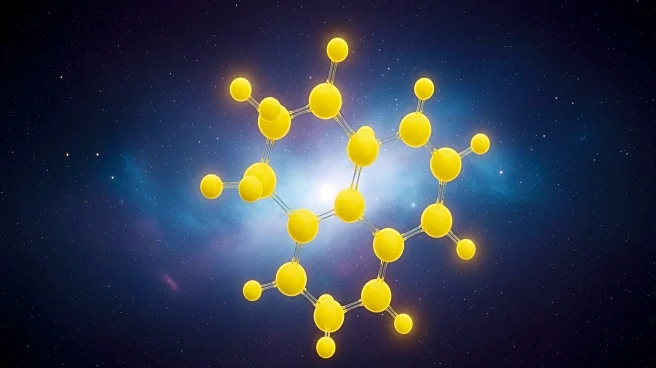
Astronomers have detected the largest sulfur-bearing molecule, thiepine, in interstellar space, marking a significant discovery in the study of life's cosmic origins. This complex molecule was found in the molecular
cloud G+0.693-0.027, a star-forming region near the Milky Way's center. The discovery was made by researchers from the Max Planck Institute for Extraterrestrial Physics and the CSIC-INTA Centro de Astrobiología. By synthesizing the molecule in the lab and comparing it to astronomical data, scientists confirmed its presence, suggesting that the chemical groundwork for life begins in space.
Why It's Important?
The detection of thiepine in interstellar space provides crucial insights into the chemical processes that may lead to the formation of life. This discovery bridges the gap between the types of organic molecules found in meteorites and those observed in space, suggesting that life's building blocks are more widespread than previously thought. Understanding these processes can inform the search for life beyond Earth and enhance our knowledge of how life might arise in different environments. The findings also support the idea that complex organic chemistry occurs in space, potentially seeding planets with the ingredients for life.
What's Next?
Following this discovery, astronomers will likely continue searching for other complex sulfur-bearing molecules in interstellar space. These efforts could lead to a more comprehensive understanding of the chemical diversity in space and its implications for life's origins. Future research may focus on identifying similar molecules in other star-forming regions, providing further evidence of the universality of these processes. The findings may also inspire new laboratory experiments to replicate and study these molecules, advancing our understanding of astrochemistry and its role in the emergence of life.