
What's Happening?
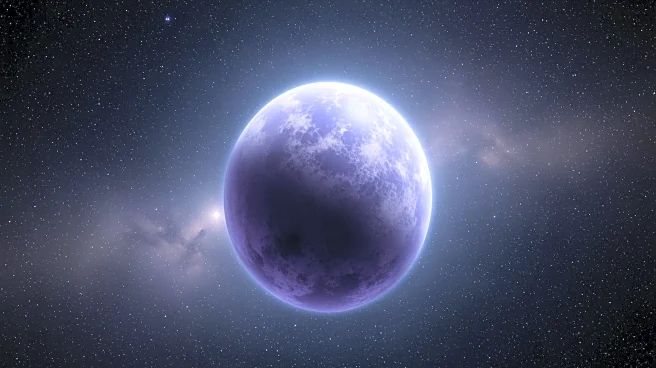
Astronomers have successfully measured the mass and distance of a newly discovered free-floating planet, a significant achievement in the study of rogue planets. This was accomplished by observing the planet simultaneously
from Earth and space, a method that allowed for the capture of details typically missing for such faint objects. The planet, with a mass about 22% that of Jupiter, is located roughly 3,000 parsecs from the center of the Milky Way. The study, led by Subo Dong and colleagues, utilized data from ground-based surveys and the Gaia space telescope to determine the planet's characteristics. This discovery highlights the potential of simultaneous space- and ground-based observations in understanding how planets form and evolve across the galaxy.
Why It's Important?
The ability to measure the mass and distance of rogue planets is crucial for understanding the dynamics of planetary systems. These free-floating planets, which do not orbit a star, provide insights into the processes that can eject planets from their original systems. The findings could influence future exploratory missions and enhance our understanding of planetary formation. The upcoming NASA Nancy Grace Roman Space Telescope, set to launch in 2027, is expected to further this research, potentially increasing the number of identified rogue planets and refining our knowledge of their origins and characteristics.
What's Next?
The study suggests that the number of identified free-floating planets is likely to grow as observational techniques improve. The NASA Nancy Grace Roman Space Telescope will play a significant role in this expansion, offering new opportunities to study these solitary planets. Future missions may focus on simultaneous observations to capture more detailed data, which could lead to breakthroughs in understanding the formation and evolution of planetary systems. This research could also inform the planning of future space missions aimed at exploring these mysterious objects.