
What's Happening?
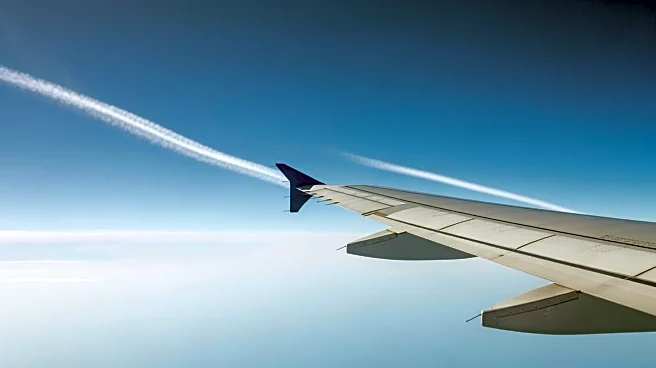
A recent study by Transport & Environment (T&E) highlights the significant climate impact of contrails, the white lines left by aircraft, which contribute to global warming by trapping heat in the atmosphere.
The study reveals that 25% of European aviation's contrail-related warming is caused by night flights during autumn and winter, despite these flights constituting only 10% of air traffic. T&E suggests that minor adjustments in flight paths, such as rerouting to avoid cold and humid atmospheric regions, could significantly reduce contrail formation. The study emphasizes the potential for contrail avoidance in areas with high warming but low traffic, such as the North Atlantic, where long-haul flights contribute disproportionately to contrail warming.
Why It's Important?
The findings underscore the potential for significant climate benefits through relatively simple changes in air traffic management. By targeting specific flights and times of the year, the aviation industry could reduce its environmental impact without major disruptions. This approach not only addresses contrail-induced warming but also complements efforts to reduce CO2 emissions. Implementing these strategies could position Europe as a leader in sustainable aviation practices, potentially influencing global aviation policies. The study's recommendations for policy frameworks and large-scale trials could pave the way for broader adoption of contrail avoidance techniques, offering a cost-effective solution to mitigate aviation's climate impact.
What's Next?
T&E recommends that the European Union incorporate contrail avoidance into air traffic management legislation and extend non-CO2 monitoring schemes to flights outside the European Economic Area. Incentives for airlines and air traffic control centers to adopt contrail avoidance practices are also suggested. The study calls for large-scale airspace trials to enhance understanding and implementation of these strategies. If adopted, these measures could lead to significant reductions in aviation-related global warming, setting a precedent for other regions to follow.