






What's Happening?
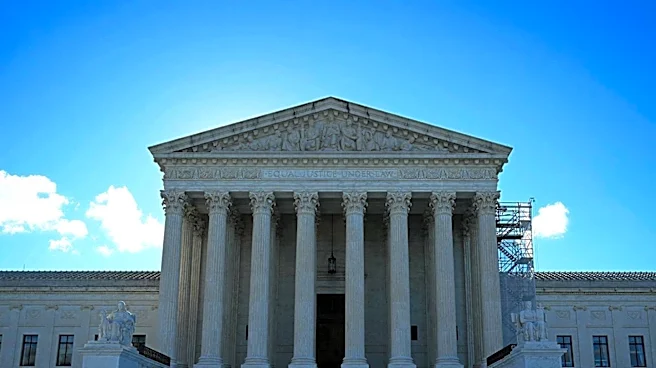
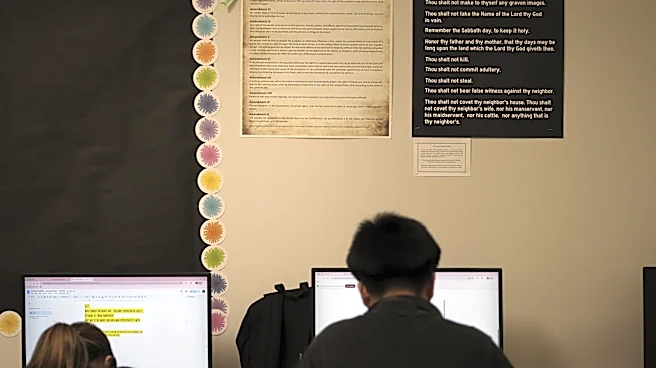
More than two dozen Texas families have formally requested the Supreme Court to review a state law that mandates the display of the Ten Commandments in public school classrooms. This petition, filed by the American Civil Liberties Union of Texas and other
legal and religious-liberty advocacy groups, argues that a lower court ruling upholding the law 'gutted the religious freedom rights of public-school children and parents.' The filing specifically contends that the 5th Circuit Court of Appeals disregarded a 1980 Supreme Court decision that deemed a nearly identical Kentucky statute unconstitutional. The families involved represent diverse religious and nonreligious backgrounds, including Christian, Jewish, Hindu, Baha’i, Unitarian Universalist, and nonreligious individuals, attending 22 different school districts across Texas.
Why It's Important?
This case carries significant national importance as legislatures in numerous states have considered similar laws regarding the display of the Ten Commandments in public schools over the past two years. If the Texas law is allowed to stand, it could embolden other state and local governments to enact similar measures, potentially leading to widespread 'incursions on public-school families’ religious freedom.' This would create an 'administrative nightmare and litigation risk for school districts' and diminish parental control over their children's religious education. The core issue revolves around the Establishment and Free Exercise Clauses of the First Amendment, specifically the separation of church and state in public education. The outcome could redefine the boundaries of religious expression in public institutions and impact the religious liberty of students and families nationwide.
What's Next?
The Supreme Court will now decide whether to hear the case. If the Court agrees to review the Texas law, its decision will have far-reaching implications for similar legislation across the United States. A ruling upholding the Texas law could encourage other states to implement similar mandates, while a decision striking it down would reinforce the precedent set by the 1980 Kentucky case. Regardless of the Supreme Court's decision, the issue is likely to remain a contentious point in the ongoing debate about religious freedom and the role of religion in public education. Advocacy groups on both sides will continue to monitor legislative efforts and legal challenges related to the display of religious texts in public institutions.
Beyond the Headlines
This legal challenge extends beyond the mere display of a religious text; it touches upon the fundamental principles of religious pluralism and the protection of minority beliefs within public education. The plaintiffs, including a rabbi, highlight the concern that forcing a specific version of the Ten Commandments, often interpreted through a Christian lens, upon children in classrooms can be particularly upsetting and exclusionary for those of different faiths or no faith. This case underscores the delicate balance between respecting religious heritage and ensuring that public schools remain inclusive and neutral environments for all students. The long-term implications could influence how religious diversity is acknowledged and protected in educational settings, potentially shaping future policies on curriculum, school prayer, and the display of religious symbols in public spaces.