





What's Happening?
New research by a team of glaciologists indicates that the Thwaites Glacier in West Antarctica, known as the 'Doomsday Glacier,' is melting 'more aggressively' than previously understood. This accelerated melting could lead to global sea level rise double
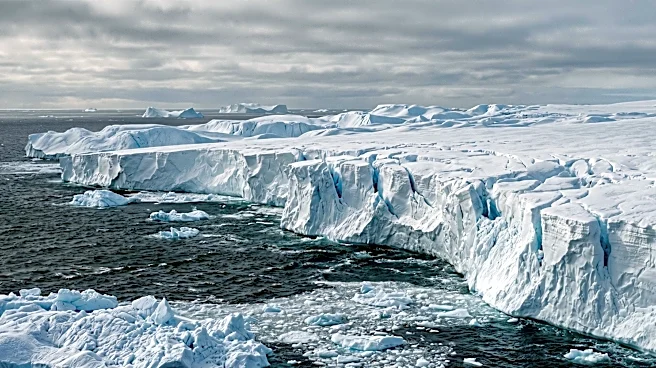
current estimates. The Florida-sized glacier, which currently contributes about 4% to global sea level rise, is a critical factor in forecasting future sea levels. Scientists from the University of California, Irvine, and NASA's Jet Propulsion Laboratory developed a new ice sheet model that better reflects the processes occurring beneath the glacier. They found that the glacier's rapid retreat is driven by processes at its 'grounding zone,' a dynamic area where seawater constantly flushes in and out, causing vigorous melting deep beneath the ice. Incorporating this 'grounding zone' concept into models suggests Thwaites could contribute up to 1.2 inches of sea level rise by 2100, even without further global warming, which is twice previous projections.
Why It's Important?
The revised projections for the Thwaites Glacier's contribution to sea level rise have significant implications for coastal communities worldwide, including those in the U.S. A 1.2-inch increase in global sea levels, while seemingly small, can substantially magnify the risks of coastal flooding, storm surges, and erosion. This increased vulnerability poses threats to infrastructure, ecosystems, and human populations in low-lying areas. The glacier's potential collapse could ultimately lead to around 10 feet of sea level rise, devastating major coastal cities. The findings underscore the urgency of addressing climate change and its impacts, as the damage already done to the planet's ice sheets is accelerating, necessitating more robust adaptation and mitigation strategies to protect vulnerable regions.
What's Next?
The immediate next step for scientists is to gather more direct observational data from beneath the Thwaites Glacier. Researchers are planning an expedition in 2028 to deploy instruments capable of documenting the flushing of seawater in and out of the grounding zone. This data will be crucial for refining models and making more confident predictions about the rate of ice loss. Policy-wise, these findings will likely intensify calls for global action to cut planet-heating pollution to limit further impacts. Coastal communities and governments will need to re-evaluate existing sea-level rise projections and update their long-term planning for coastal defense, infrastructure development, and population relocation strategies to account for the increased risk.
Beyond the Headlines
The aggressive melting of the Thwaites Glacier highlights a critical feedback loop in climate change: as ice melts, more ice is exposed to warm ocean water, accelerating the process. This research also points to the complexity of glacial dynamics, where previously overlooked factors like the 'grounding zone' can significantly alter projections. The 'Doomsday Glacier' serves as a stark reminder of the potential for non-linear and rapid changes in Earth's climate system, challenging previous assumptions about the pace of environmental degradation. Ethically, these findings place a greater burden on current generations to act decisively on climate change, as the consequences of inaction will disproportionately affect future generations and vulnerable populations. The scientific community's continuous refinement of climate models underscores the dynamic nature of climate science and the ongoing need for research and adaptation.