



What's Happening?
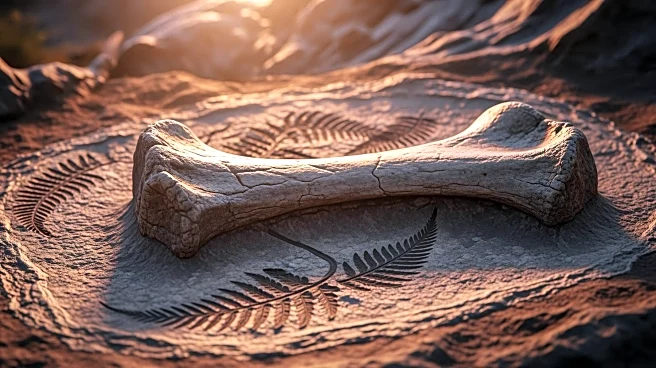
Researchers have unveiled a near-complete skeleton of Alnashetri cerropoliciensis, a small, bird-like dinosaur from the Cretaceous period, discovered in the La Buitrera fossil area of northern Patagonia, Argentina. This specimen, weighing under 2 pounds,
provides a crucial reference point for understanding the alvarezsaurs, a group of theropods previously difficult to interpret due to fragmentary fossils. The study, led by Peter Makovicky and Sebastián Apesteguía, was published in Nature and highlights the significance of this find in mapping the evolutionary transitions of these dinosaurs. The fossil's preservation allows for detailed anatomical analysis, revealing that Alnashetri was an adult, challenging previous assumptions about the size and development of alvarezsaurs.
Why It's Important?
The discovery of Alnashetri cerropoliciensis is pivotal for paleontologists studying dinosaur evolution, particularly in South America, where alvarezsaur fossils have been scarce and incomplete. This find provides a 'Rosetta Stone' for understanding the anatomy and evolutionary history of this group, offering insights into their size, age, and anatomical features. The research challenges previous theories of evolutionary miniaturization, suggesting instead a repeated evolution within a narrow body size range. This has broader implications for understanding the diversity and adaptability of dinosaurs in different environments and geological periods.
What's Next?
The research team plans to continue analyzing the Alnashetri fossil and other specimens from the La Buitrera site to further explore the evolutionary history of alvarezsaurs and other small-bodied Cretaceous vertebrates. The findings may lead to a reevaluation of existing fossil records and prompt new excavations in the region. Additionally, the study's implications for biogeography and the distribution of species during the breakup of Pangaea could inspire further research into the movement and adaptation of ancient species across continents.
Beyond the Headlines
The La Buitrera fossil area has proven to be a rich source of paleontological data, offering a unique window into the life of small dinosaurs and other vertebrates during the Cretaceous period. This discovery highlights the importance of preserving and studying fossil sites, as they provide invaluable insights into Earth's biological history and the evolutionary processes that have shaped life on our planet. The research also underscores the interconnectedness of ancient ecosystems and the role of geographic and environmental factors in shaping the diversity of life.