





What's Happening?
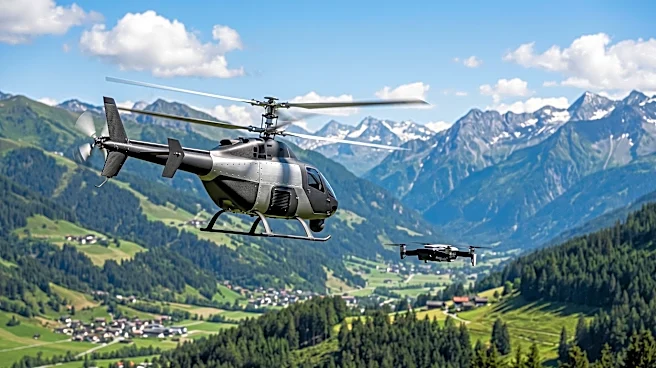
Schiebel, an Austrian aerospace manufacturer, in collaboration with OSIRIS Poland, has successfully demonstrated its CAMCOPTER S-100 unmanned helicopter acting as a 'drone mothership.' During a proof-of-concept demonstration in Austria, the S-100 carried
and deployed a smaller OSIRIS HSCD-1 (High-Speed Camera Drone) while in forward flight. Following its release, the smaller drone remained under operator control through a communications link relayed by the S-100. This demonstration highlights the S-100's ability to serve as an airborne carrier, launch platform, and communications relay for smaller unmanned systems. The HSCD-1 used in the trial was an inert variant, meaning it did not carry a warhead or engage in live interception. Schiebel indicates that this concept could be adapted to carry high-speed interceptor drones equipped with effectors, as well as loitering munitions, extending the operational reach and flexibility of smaller drones beyond conventional ground-based launch and control systems. The company also suggests that other platforms in its CAMCOPTER series, such as the S-300, S-101, and S-301, could potentially serve similar roles.
Why It's Important?
This technological advancement is significant for military and defense applications, particularly in the realm of Counter-Unmanned Air System (C-UAS) operations. The ability of a larger unmanned aircraft to deploy and control smaller drones from the air can dramatically extend the operational range and endurance of these smaller systems. This means that interceptor drones or reconnaissance drones, which typically have limited range and battery life, could be transported closer to their targets or areas of interest before deployment, thereby maximizing their mission effectiveness. For naval forces, which already utilize the S-100 for surveillance, this 'mothership' capability offers a new dimension for counter-drone measures without requiring new airframes or crews. The U.S. Army has also explored similar concepts with crewed aircraft, indicating a broader interest in such multi-drone operational strategies. This development could lead to more flexible and responsive drone operations, enhancing surveillance, reconnaissance, and defensive capabilities against aerial threats.
What's Next?
While the demonstration was a proof-of-concept, Schiebel aims to further develop this 'drone mothership' capability, particularly for counter-drone work. The company envisions the S-100 carrying high-speed interceptor drones equipped with effectors, allowing them to be positioned closer to incoming threats. However, no specific customer, contract, or in-service date has been announced, suggesting that further testing and validation will be required before widespread adoption. The next steps will likely involve demonstrating the system with armed interceptors and in more complex operational scenarios, potentially including maritime environments where the S-100 is already widely used. The U.S. military's interest in similar concepts suggests that this technology could eventually find its way into American defense strategies, offering enhanced capabilities for drone deployment and counter-drone operations.
Beyond the Headlines
The concept of a 'drone mothership' represents a significant shift in unmanned aerial systems strategy, moving towards more integrated and layered drone operations. This approach could lead to a future where military operations rely on networks of interconnected drones, with larger platforms acting as mobile launchpads and communication hubs for smaller, specialized units. This could raise ethical and legal questions regarding autonomous weapon systems, especially if interceptor drones are deployed with lethal effectors. The increased complexity of such systems also demands robust cybersecurity measures to prevent unauthorized access or manipulation. Furthermore, the ability to extend the reach of smaller drones could impact geopolitical dynamics, particularly in regions with contested airspace or where surveillance and reconnaissance are critical. The development underscores a broader trend in military technology towards distributed, networked, and increasingly autonomous systems, potentially reshaping future aerial warfare and defense strategies.