



What's Happening?
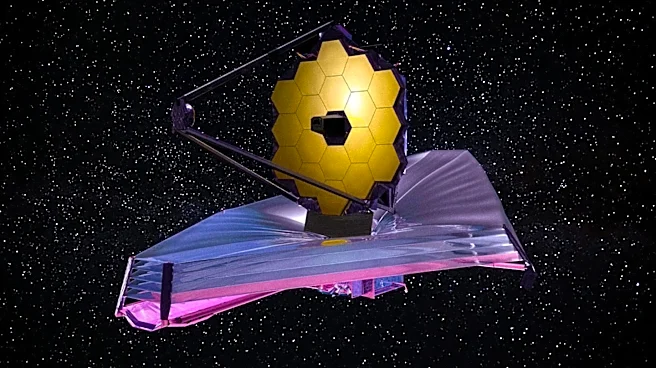
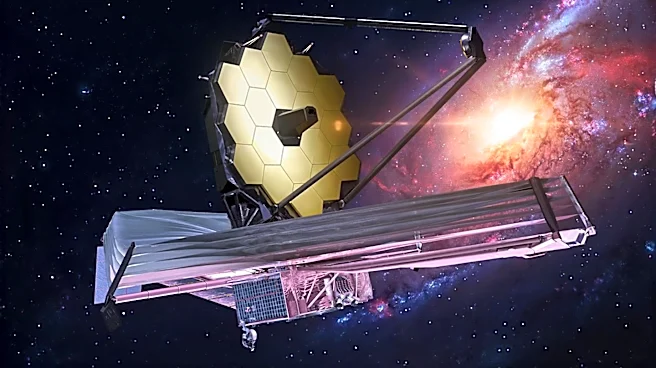
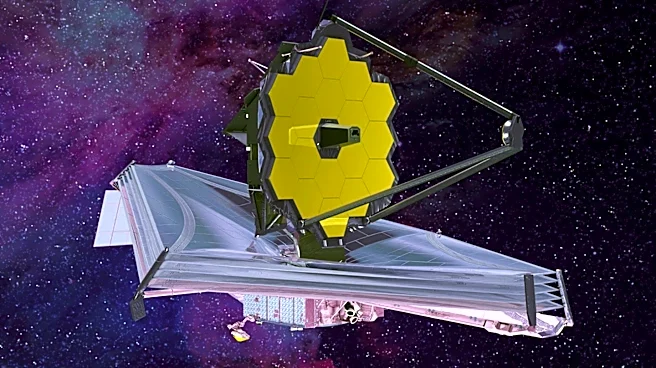
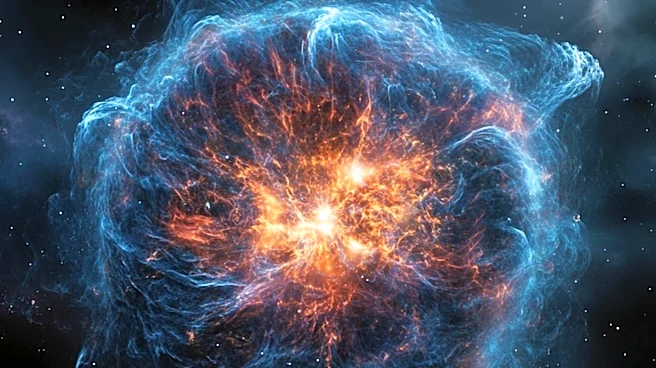
The James Webb Space Telescope (JWST) has observed a major merger of at least five galaxies, known as JWST's Quintet, occurring about 800 million years after the Big Bang. This discovery, detailed in a Nature Astronomy paper, reveals a complex system
at redshift 6.7, where galaxies are colliding, forming stars rapidly, and dispersing heavy elements into the surrounding gas. The system, located in the GOODS-South field, consists of more than 17 galaxy-sized clumps and a total stellar mass of approximately 10 billion solar masses. The galaxies are forming stars at a rate significantly higher than typical for their epoch, indicating a dynamic and mature chemical environment much earlier than previously thought.
Why It's Important?
This finding challenges the traditional view of the early universe as a simple and orderly place. The presence of heavy elements and rapid star formation in JWST's Quintet suggests that some processes associated with later galaxy evolution were already active shortly after the Big Bang. This has implications for our understanding of galaxy formation and evolution, as well as the distribution of elements in the universe. The discovery provides direct evidence of environmental metal enrichment through merger-induced tidal stripping, offering insights into how galaxies and their environments evolved in the early universe.
What's Next?
Further observations and studies are needed to determine how common such early galaxy mergers are. If similar systems are found, models of early galaxy growth and chemical enrichment may need to be revised to account for these dynamic environments. The JWST's capabilities will continue to be utilized to explore the early universe, potentially uncovering more about the formation and evolution of galaxies. Understanding the frequency and impact of these early mergers could provide a clearer picture of the universe's development in its first billion years.