

What's Happening?
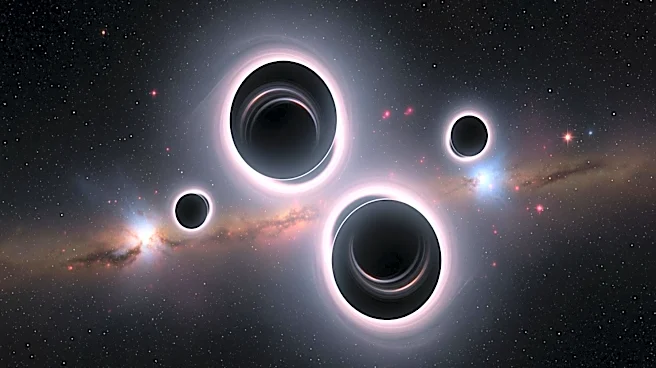
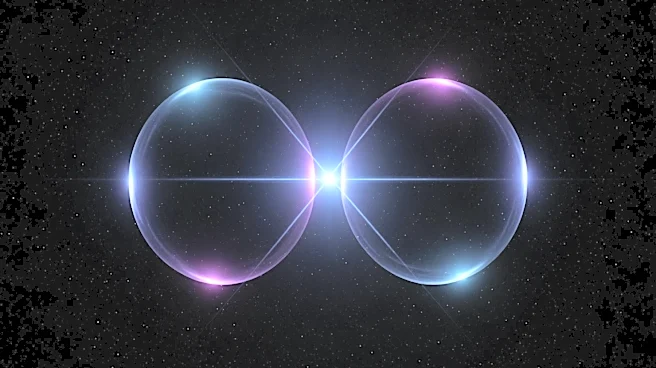
Astronomers analyzing data from the LIGO-Virgo-KAGRA Collaboration have discovered that merging binary black holes fall into three distinct subpopulations. The study, based on gravitational-wave data, reveals that these subpopulations have unique characteristics
in terms of masses, spin behavior, and merger rates, suggesting different formation mechanisms. The research indicates that the overall population of merging black holes may not share the same origins, with distinct peaks in mass and spin distributions pointing to multiple formation channels.
Why It's Important?
This discovery is significant as it enhances the understanding of black hole formation and evolution, providing insights into the complex processes that govern these cosmic phenomena. The identification of distinct subpopulations could lead to advancements in astrophysics, influencing theories about the universe's structure and the lifecycle of stars. This research may also impact future studies on gravitational waves and the development of technologies to detect and analyze cosmic events, contributing to the broader field of space exploration and scientific discovery.
What's Next?
Researchers plan to continue analyzing data from upcoming releases by the LIGO-Virgo-KAGRA collaboration to refine their understanding of black hole formation channels. Further studies may focus on identifying additional subpopulations or exploring the implications of these findings on existing astrophysical models. The scientific community will likely engage in discussions and collaborations to expand knowledge in this area, potentially leading to new theories and technological advancements in the study of black holes and gravitational waves.