






What's Happening?
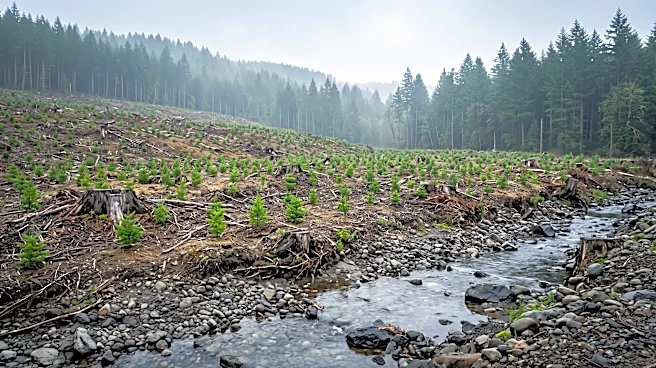
The Oregon Department of Forestry (ODF) has approved a plan for Stimson Lumber Company to apply the rodenticide Rozol across 246.8 acres of recently logged private timberland in Tillamook County, Oregon. This application, scheduled between September 24 and December
31, 2026, aims to prevent mountain beavers from damaging newly planted saplings. Rozol, with the active ingredient chlorophacinone, is an anticoagulant that causes internal bleeding and death. The North Coast Communities for Watershed Protection (NCCWP) has raised concerns about this practice, highlighting that the planned application sites are within 100 feet of streams and wetlands, including Foley Creek, which flows into the Nehalem River. The NCCWP argues that this common forest management practice poses risks to drinking water sources, air quality, and wildlife, as Rozol is highly toxic to humans if ingested and presents a secondary hazard to predators that consume affected mountain beavers.
Why It's Important?
This decision underscores the ongoing tension between industrial forestry practices and environmental conservation in the U.S. Pacific Northwest. The use of rodenticides like Rozol is a widespread practice in Oregon's timber industry, intended to protect reforestation efforts by controlling mountain beaver populations that feed on young trees. However, the NCCWP's opposition highlights significant environmental and public health concerns. The proximity of the application sites to water bodies raises questions about potential contamination of drinking water and harm to aquatic ecosystems. Furthermore, the anticoagulant nature of Rozol means it can persist in the bodies of dead animals, posing a secondary poisoning risk to predators such as cougars, mink, and great horned owls, thereby impacting the broader food web and biodiversity. This situation exemplifies the challenges in balancing economic interests in timber production with the imperative to protect natural resources and public health.
What's Next?
The application of Rozol is set to proceed between late September and the end of 2026, as approved by the Oregon Department of Forestry. Stimson Lumber Company will likely move forward with the application to protect its timber investments. Environmental groups like the North Coast Communities for Watershed Protection are expected to continue their advocacy against such practices, potentially through public awareness campaigns, lobbying efforts, or legal challenges to push for stricter regulations on pesticide use in forests. This event may also prompt further discussions and reviews of current forest management policies in Oregon, particularly regarding the use of rodenticides and their environmental impact. The long-term consequences for local ecosystems and water quality will be closely monitored by environmental organizations and affected communities.
Beyond the Headlines
The debate over rodenticide use in Tillamook County reflects a deeper, systemic conflict within U.S. forestry: the prioritization of timber yield over ecological integrity. The practice of clearcutting, which removes all other food sources for mountain beavers, inadvertently creates the very problem that rodenticides are then used to solve. This cycle raises ethical questions about human intervention in natural ecosystems and the sustainability of current industrial logging models. The reliance on chemical solutions to manage wildlife populations, rather than adopting more holistic and ecologically sensitive forestry practices, points to a broader challenge in environmental stewardship. This situation could catalyze a re-evaluation of integrated pest management strategies in forestry, encouraging a shift towards methods that minimize harm to non-target species and preserve the complex interdependencies within forest ecosystems, such as the role of mycorrhizae transported by mountain beavers.