
What's Happening?
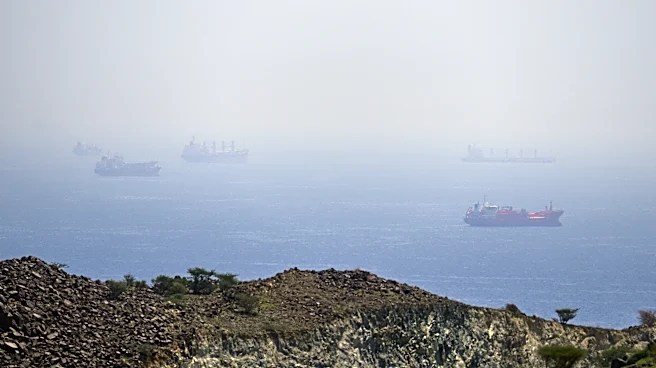
President Donald Trump has accused Iran of committing a 'serious violation' of a ceasefire agreement, following an incident in the Strait of Hormuz where Iran allegedly fired bullets at a French ship and
a UK freighter. Despite this, Trump remains optimistic about securing a peace deal with Iran, stating that it will happen 'one way or another.' The U.S. is sending representatives, including Vice President JD Vance, special envoy Steve Witkoff, and Jared Kushner, to Islamabad, Pakistan, for negotiations. Iran, however, has reportedly not planned to send a delegation while the U.S. maintains a naval blockade over the Strait of Hormuz.
Why It's Important?
The situation underscores ongoing tensions between the U.S. and Iran, particularly in the strategically significant Strait of Hormuz, a vital passage for global oil shipments. The U.S. administration's approach to handling the ceasefire violation and its insistence on a peace deal could have significant implications for international relations and regional stability. The involvement of high-profile U.S. officials in the negotiations highlights the importance the administration places on resolving the conflict. The outcome of these talks could affect global oil markets and influence U.S. foreign policy in the Middle East.
What's Next?
The U.S. delegation's visit to Pakistan for negotiations marks a critical step in addressing the ceasefire violation and pursuing a peace deal. The international community will be closely watching the outcome of these talks, as they could lead to either a de-escalation of tensions or further conflict. The U.S. has indicated a willingness to take military action if necessary, which could have far-reaching consequences for regional security and global economic stability. The response from Iran and other stakeholders will be pivotal in determining the next phase of this geopolitical issue.