
What's Happening?
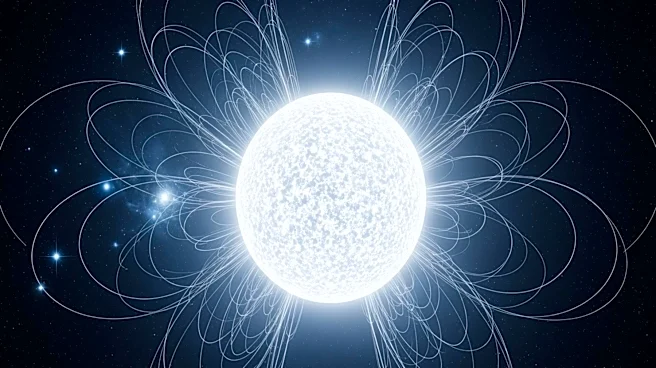
Scientists, acting as stellar archaeologists, have discovered fossilized magnetism on white dwarfs, which may provide insights into the evolution of stars, including our sun. This research connects magnetic
fields observed on white dwarfs to those detected at the cores of red giants, suggesting that these fields persist throughout a star's life. The study utilized asteroseismology to measure stellar oscillations, supporting the fossil field theory of stellar magnetism. This theory posits that magnetic fields formed early in a star's life re-emerge on white dwarfs billions of years later. The findings suggest that magnetic fields play a crucial role in a star's evolution, influencing its lifespan and internal processes.
Why It's Important?
Understanding stellar magnetism is vital for predicting the future of our sun and similar stars. The discovery that magnetic fields persist from the red giant phase to the white dwarf stage could reshape models of stellar evolution. This research highlights the potential for magnetic fields to influence a star's lifespan and internal dynamics, which could have implications for the future of our solar system. If the sun's core is magnetic, it could alter current predictions about its remaining lifespan and behavior. This study also emphasizes the importance of magnetic fields in stellar evolution, which could lead to new insights into the life cycles of stars.
What's Next?
Further research is needed to confirm the presence of magnetic fields in the sun's core, which could significantly impact current models of stellar evolution. Scientists may also explore how magnetic fields influence the transfer of hydrogen in stars, potentially extending their lifespans. Continued study of white dwarfs and red giants will help refine the fossil field theory and improve understanding of stellar magnetism. These efforts could lead to more accurate predictions about the future of our sun and other stars, enhancing our knowledge of the universe's evolution.