
What's Happening?
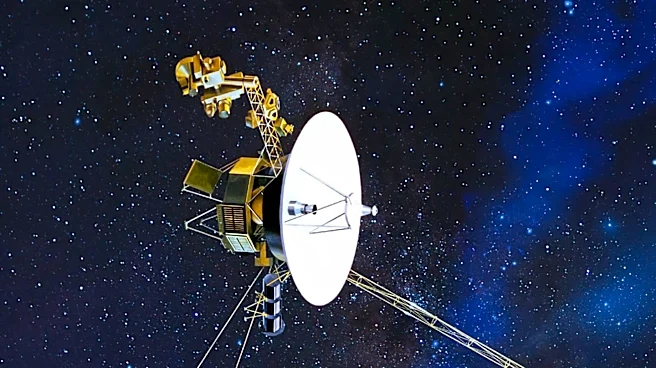
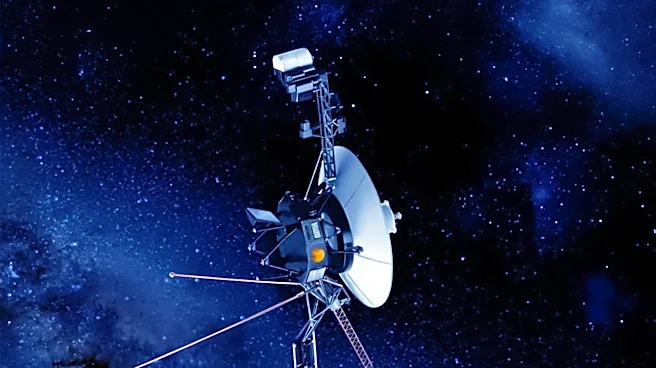
NASA engineers have successfully extended the Voyager 2 mission by at least one year through innovative power management techniques. The team at the Jet Propulsion Laboratory executed a coordinated operation,
dubbed the 'Big Bang,' to swap powered devices with lower-power alternatives, preserving the spacecraft's functionality. This effort allows Voyager 2 to continue its interstellar measurements without losing another science instrument until at least the end of 2027. The mission, which began in 1977, relies on radioisotope thermoelectric generators for power, losing about four watts annually.
Why It's Important?
The extension of the Voyager 2 mission is a testament to the ingenuity and resourcefulness of NASA engineers, demonstrating the ability to adapt and extend the life of space missions beyond their original design. The data collected by Voyager 2 is invaluable for understanding interstellar space, providing unique insights that cannot be replicated by other spacecraft. This achievement underscores the importance of long-term planning and innovative problem-solving in space exploration, offering lessons that could be applied to future missions and the development of sustainable space technologies.
What's Next?
NASA plans to implement a similar power-saving strategy on Voyager 1, potentially extending its mission as well. The continued operation of both Voyager spacecraft will provide further opportunities to study the heliopause and interstellar space, contributing to our understanding of the solar system's boundary. As the spacecraft continue to travel farther from the Sun, the data they collect will become increasingly valuable, offering a rare glimpse into the conditions of deep space. The success of these efforts may influence future mission planning and the design of long-duration space probes.