
What's Happening?
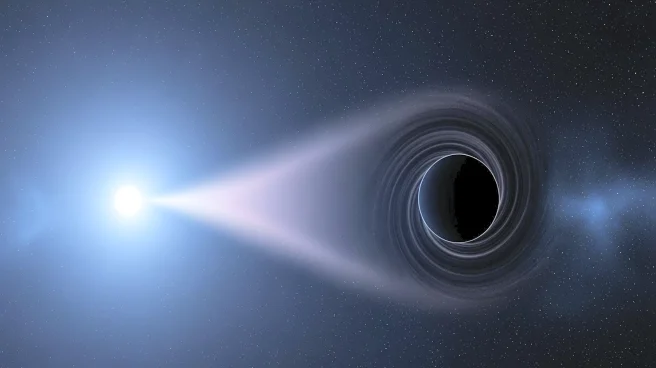
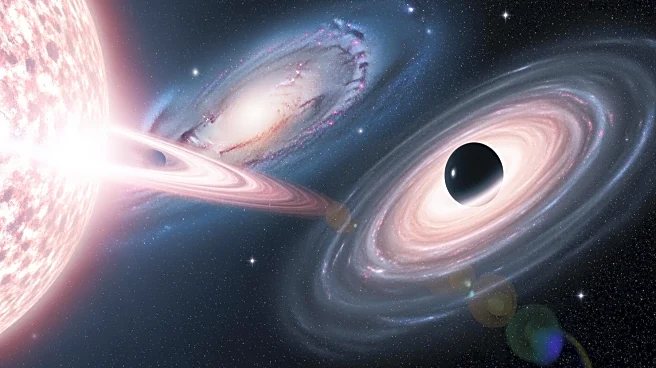
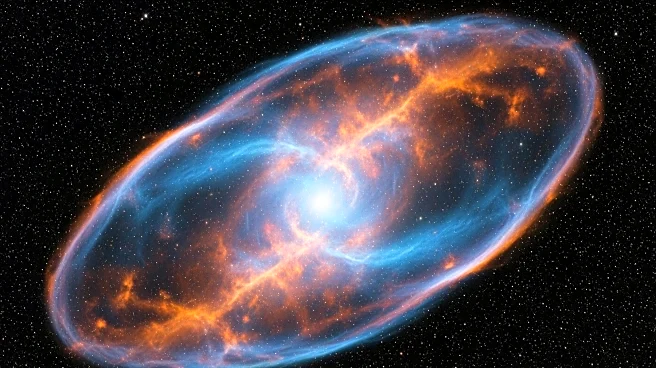
Astronomers have obtained their clearest view yet of a star collapsing directly into a black hole, a phenomenon observed in the Andromeda Galaxy. The event was discovered in archival data from NASA's NEOWISE mission, which captured infrared light from the star brightening
before it faded and disappeared. The star, named M31-2014-DS1, underwent direct collapse without first exploding as a supernova, a process previously predicted but not fully observed. The star, initially 13 times the mass of the Sun, shed its material into space before collapsing. This discovery, led by Kishalay De of Columbia University, challenges existing assumptions about stellar deaths and the formation of black holes.
Why It's Important?
This observation provides critical insights into the processes leading to black hole formation, challenging the traditional understanding that stars of certain masses always explode as supernovae. The direct collapse of a star into a black hole without a supernova explosion suggests that stellar deaths may be more varied than previously thought. This finding could have significant implications for astrophysics, particularly in understanding the life cycles of massive stars and the conditions under which black holes form. It also highlights the value of archival data in uncovering new astronomical phenomena.
Beyond the Headlines
The discovery of a star collapsing directly into a black hole without a supernova explosion raises questions about the mechanisms governing stellar evolution and death. It suggests that factors such as gravity, gas pressure, and shock waves may interact in complex ways, influencing whether a star explodes or collapses. This event also underscores the importance of re-examining archival data, as significant discoveries may be hidden in existing datasets. The implications for our understanding of the universe's inventory of massive stellar deaths are profound, potentially altering models of galaxy evolution and black hole formation.