



What's Happening?
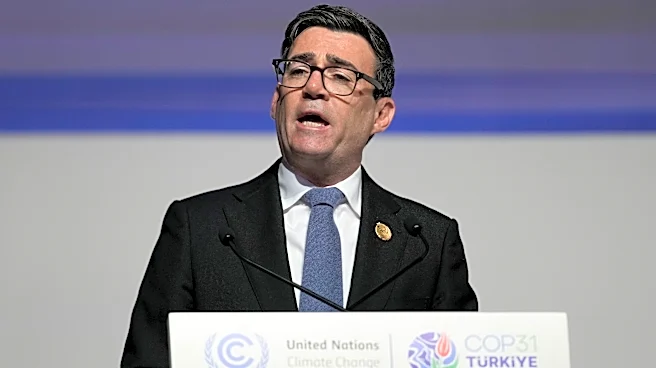
United Nations Secretary-General Antonio Guterres has called for urgent and widespread reductions in greenhouse gas emissions to minimize the duration and impact of global temperature rises. Speaking at the final press conference of the UN climate change
conference (COP-31), Guterres emphasized the necessity of cutting emissions by approximately six percent annually in the coming years. He warned that even with current climate commitments under Nationally Determined Contributions (NDCs), global temperatures could still rise above 2.5 degrees Celsius by the end of the century. Guterres stressed the responsibility to keep temperature increases above 1.5 degrees Celsius to a minimum, limit them to the shortest possible period, and bring temperatures back below 1.5 degrees as quickly as possible. He also highlighted that climate justice is increasingly vital, as even limited temperature rises will exacerbate existing climate-related destructive impacts.
Why It's Important?
The Secretary-General's call underscores the critical need for immediate and substantial global action to combat climate change, directly impacting U.S. climate policy and economic strategies. The U.S., as a major emitter, faces pressure to align with these global targets, which could influence domestic energy policies, industrial regulations, and investment in renewable technologies. Failure to meet these targets could lead to more severe climate disasters, affecting U.S. infrastructure, agriculture, and public health, and increasing economic costs associated with recovery and adaptation. Furthermore, Guterres's emphasis on climate justice implies that developed nations, including the U.S., must fulfill financial commitments to support developing countries in adaptation and addressing losses, potentially leading to increased international aid obligations and diplomatic pressures. The transition away from fossil fuels, as advocated by Guterres, also has significant implications for the U.S. energy sector, potentially accelerating the shift towards clean energy and impacting fossil fuel industries.
What's Next?
Following the UN Secretary-General's statements, the focus will likely shift to how individual nations, including the U.S., will revise and implement their climate commitments. This could involve new legislative efforts to reduce emissions, increased investment in renewable energy infrastructure, and stricter regulations on industries contributing to greenhouse gas output. International negotiations and future COP conferences will continue to be crucial platforms for monitoring progress and setting more ambitious targets. Developing countries will likely increase their demands for financial support from developed nations, putting pressure on the U.S. to contribute more significantly to climate adaptation and loss and damage funds. The private sector in the U.S. may also face increased pressure to adopt sustainable practices and invest in green technologies, driven by both government policies and consumer demand. The ongoing dialogue will also involve discussions on equitable transitions away from fossil fuels, which could lead to new international agreements and partnerships.
Beyond the Headlines
The Secretary-General's remarks extend beyond immediate policy changes, touching upon deeper ethical and societal implications. His assertion that 'peace cannot be kept on a burning planet' links climate change directly to global instability, human rights, and social justice. This perspective suggests that climate action is not merely an environmental issue but a fundamental component of national security and international relations. For the U.S., this implies that climate policy must be integrated into broader foreign policy and national security strategies, recognizing climate-induced migration, resource scarcity, and conflict as growing threats. The call for climate justice also highlights historical responsibilities, urging developed nations to address the disproportionate impact of climate change on vulnerable communities globally. This could foster a re-evaluation of global economic inequalities and the moral obligations of wealthier nations, potentially leading to new frameworks for international cooperation and aid that prioritize climate resilience and equity.