






What's Happening?
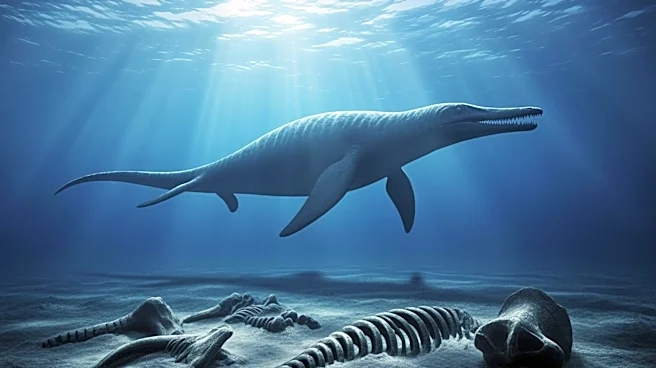
Paleontologists have identified a new species of ancient marine predator, Tylosaurus rex, which was previously misidentified as Tylosaurus proriger. This discovery was made by Michael Polcyn and Amelia Zietlow, who noticed distinct features in fossils
that had been mislabeled for decades. The Tylosaurus rex, a massive marine reptile, could grow up to 43 feet long and had sharp, serrated teeth, unlike its relatives with smooth, cone-shaped teeth. The fossils, primarily found in Texas, date back 80 million years, contrasting with the 84-million-year-old T. proriger fossils found mainly in Kansas. The most notable specimen, nicknamed 'The Black Knight,' is displayed at the Perot Museum of Nature and Science in Dallas. The findings were published in the Bulletin of the American Museum of Natural History on May 21, 2026.
Why It's Important?
The identification of Tylosaurus rex provides significant insights into the evolution and diversity of ancient marine reptiles. This discovery challenges previous understandings of the Tylosaurus genus and highlights the importance of re-evaluating existing fossil collections. By distinguishing Tylosaurus rex from T. proriger, scientists can better understand the ecological roles these predators played in their environments. This could lead to new interpretations of marine ecosystems during the Late Cretaceous period, offering a more comprehensive view of prehistoric life and evolutionary processes.
What's Next?
Following this discovery, further research is likely to focus on the ecological implications of Tylosaurus rex's existence and its interactions with other marine species. Paleontologists may conduct additional studies on the newly identified specimens to explore their physiology and behavior. Museums housing similar fossils might re-examine their collections to identify other potential misclassifications. This could lead to more discoveries and a refined understanding of marine reptile evolution.
Beyond the Headlines
The reclassification of Tylosaurus rex underscores the dynamic nature of paleontology, where new technologies and methodologies can lead to significant revisions of established scientific narratives. This case highlights the potential for overlooked specimens in museum collections to yield groundbreaking discoveries. It also raises questions about the accuracy of historical fossil classifications and the need for continuous re-evaluation as scientific techniques advance.