



What's Happening?
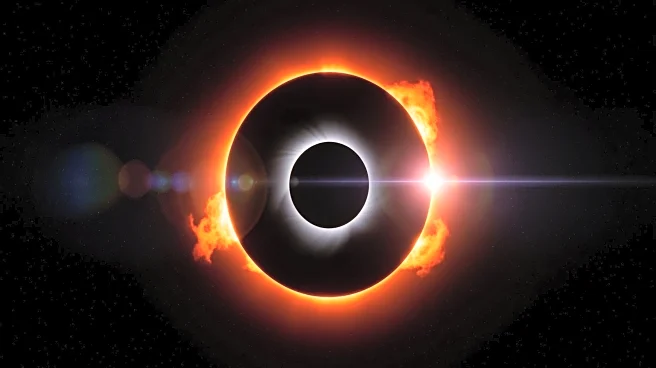
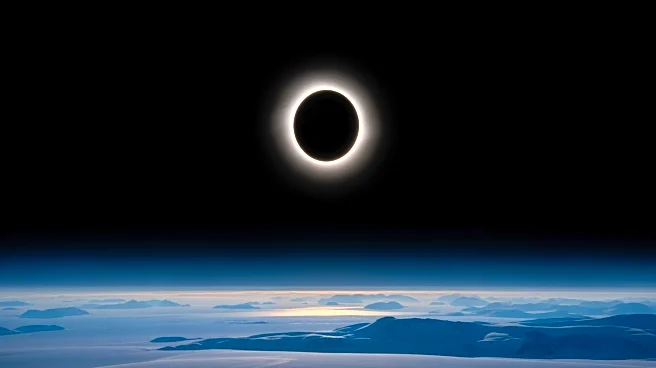
On February 17, 2026, an annular solar eclipse occurred when the Moon passed directly between the Sun and Earth. Due to the Moon's position at a distant point in its elliptical orbit, it did not completely cover the Sun, resulting in a 'ring of fire'
effect. The European Space Agency's Proba-2 satellite captured this phenomenon from space, witnessing the eclipse four times. The images were taken using the satellite's SWAP extreme ultraviolet imager. On Earth, the eclipse was visible only from Antarctica, with partial views from the southern tip of Chile, Argentina, and southern Africa. Future solar eclipses are expected to be visible from more populated regions, including a total solar eclipse on August 12, 2026, visible from Greenland, Iceland, and Spain.
Why It's Important?
The capture of the annular solar eclipse by the European Space Agency highlights the capabilities of space technology in observing celestial events. Such observations are crucial for scientific research and public interest in astronomy. The event also underscores the rarity of such eclipses being visible from remote locations like Antarctica, emphasizing the importance of satellite technology in providing global access to these phenomena. The anticipation of future eclipses visible from more populated areas may increase public engagement and interest in space science, potentially influencing educational and scientific initiatives.
What's Next?
Upcoming solar eclipses will be visible from more accessible regions, potentially increasing public interest and participation in astronomical events. The European Space Agency is preparing for three significant eclipses in the next two years, which may lead to increased scientific research and public outreach efforts. These events could also prompt discussions on the importance of space observation technologies and their role in enhancing our understanding of celestial phenomena.