


What's Happening?
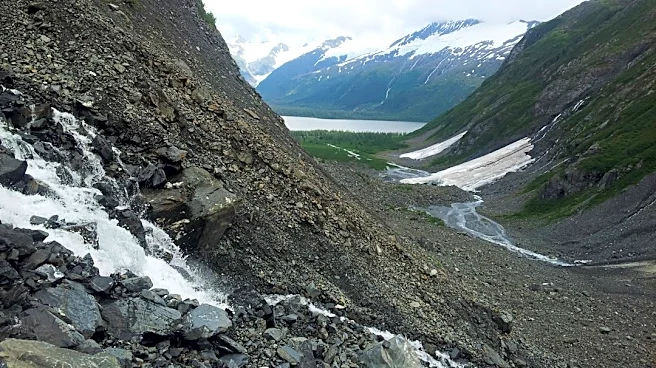
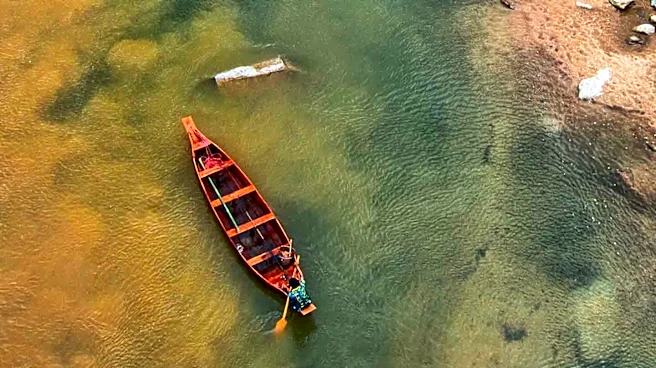
Rivers in Alaska are turning orange and becoming highly acidic, a phenomenon researchers are calling 'rusting.' This change is attributed to minerals, specifically iron and sulfuric acid, leaching from thawing permafrost in the Arctic tundra. A study
conducted in northern Alaska's Brooks Range found that these 'rusting' waters are more metallic and acidic than typical drainage from metal mines. For instance, on the Salmon River, metal levels increased seventy-fold approximately 60 miles downstream. This process began in the summer of 2019, which was the hottest summer on record for Alaska, and has since been observed in over 200 rivers across Alaska and northern Canada. Scientists, including Brett Poulin, a professor of environmental toxicology at the University of California, Davis, and co-author of the new study, were surprised by this development, noting it was not predicted in climate change assessments.
Why It's Important?
The 'rusting' of Alaskan rivers carries significant environmental implications, particularly for wildlife and local ecosystems. The increased acidity and metal content in these waters pose a direct threat to aquatic life. There are growing concerns that this phenomenon may have already contributed to the collapse of the chinook salmon fishery in the affected regions, which would have substantial economic and cultural impacts on communities reliant on these fisheries. The unexpected nature of this process highlights a gap in current climate change predictions and underscores the complex and unforeseen consequences of a warming Arctic. The widespread occurrence of this issue across Alaska and northern Canada suggests a broad ecological shift that could affect biodiversity and natural resource management in the entire Arctic region.
What's Next?
Researchers are in the early stages of understanding the full implications of these 'rusting' rivers. Future efforts will likely focus on comprehensive studies to assess the long-term ecological impacts on various species, beyond the initial concerns for chinook salmon. Monitoring the spread and intensity of this phenomenon will be crucial, as will investigating potential mitigation strategies, though these may be challenging given the vast and remote nature of the affected areas. Policymakers and environmental agencies will need to consider these new findings when developing climate adaptation plans and conservation efforts for the Arctic. The scientific community will also likely work to integrate this unexpected process into future climate models to better predict and prepare for similar environmental changes.
Beyond the Headlines
The 'rusting' of Arctic rivers points to a deeper, systemic issue related to permafrost thaw, which is a critical feedback loop in climate change. As global temperatures rise, more permafrost thaws, releasing not only trapped minerals but also greenhouse gases like methane and carbon dioxide, further accelerating warming. This particular development reveals how seemingly stable geological features can become dynamic and destructive under changing climatic conditions. The fact that this process was not anticipated by scientists underscores the limitations of current predictive models and the potential for novel environmental challenges to emerge. It also raises ethical questions about humanity's role in altering natural systems on a planetary scale and the responsibility to address these unforeseen consequences, especially for Indigenous communities whose livelihoods and cultural practices are intimately tied to these environments.