





What's Happening?
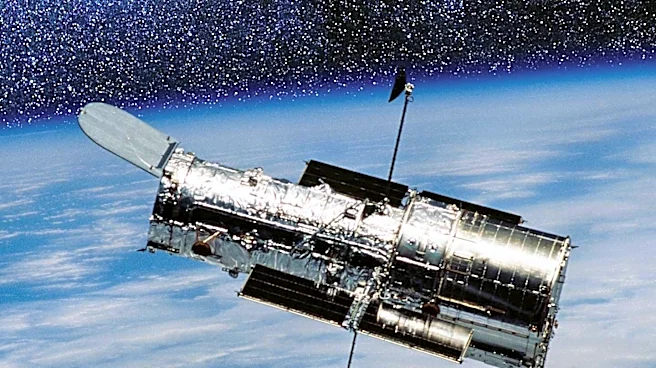
An astronomer analyzing archived data from the Hubble Space Telescope has discovered that Comet 41P/Tuttle-Giacobini-Kresák, or 41P, underwent a dramatic transformation in its rotation nearly a decade ago. Initially, observations from NASA’s Neil Gehrels
Swift Observatory in 2017 showed the comet slowing its rotation by three times. Further analysis of Hubble images from December 2017 revealed that after slowing, the comet’s rotation accelerated again and, more surprisingly, reversed its direction. This marks the first time astronomers have observed a comet reverse its spin. Researchers attribute this phenomenon to powerful outgassing activity as the comet approached the Sun. The jets of gas escaping from the comet's surface acted like small thrusters, altering its rotational movement. Comet 41P is relatively small, approximately one kilometer across, making it particularly susceptible to such forces. The study, led by astronomer David Jewitt of the University of California, Los Angeles, was published in The Astronomical Journal.
Why It's Important?
This discovery provides crucial insights into the physical evolution of small bodies within our solar system. The observation of Comet 41P's rotation reversal offers a unique, real-world example of how outgassing can profoundly influence a comet's dynamics. This understanding is vital for refining models of cometary behavior and predicting their long-term stability. The fact that 41P is a small comet highlights its vulnerability to these forces, suggesting that similar objects might undergo rapid and dramatic changes. This research contributes to a broader effort to understand comets' composition, evolution, and their potential role in delivering water and organic materials to early Earth. The ability to revisit and re-analyze archived Hubble data also underscores the enduring value of long-term astronomical data repositories for new scientific breakthroughs.
What's Next?
The lead researcher, David Jewitt, anticipates that Comet 41P is likely to self-destruct in the near future due to the continued outgassing activity potentially accelerating its spin to a point where its nucleus breaks apart. Future observations of 41P, if it remains intact, could provide further data on its rotational stability and structural integrity. The findings will also likely prompt astronomers to re-examine other comets, particularly smaller ones, for similar rotational anomalies in existing archived data. This could lead to a better understanding of the prevalence of such events and their implications for cometary lifecycles. The study also encourages continued monitoring of active comets to capture such dynamic changes in real-time, which could offer more direct evidence of the forces at play.
Beyond the Headlines
The extraordinary transformation of Comet 41P challenges previous assumptions about the stability of cometary rotation and emphasizes the dynamic nature of even seemingly familiar celestial objects. This event highlights the complex interplay between solar radiation, internal cometary composition, and mechanical forces that shape these icy bodies. The potential self-destruction of 41P serves as a stark reminder of the transient nature of many objects in the solar system and the continuous processes of creation and destruction occurring in space. Furthermore, the successful re-analysis of archival data underscores the importance of maintaining comprehensive astronomical databases, as they can yield unexpected discoveries years or even decades after the initial observations, providing new perspectives on long-standing scientific questions.