


What's Happening?
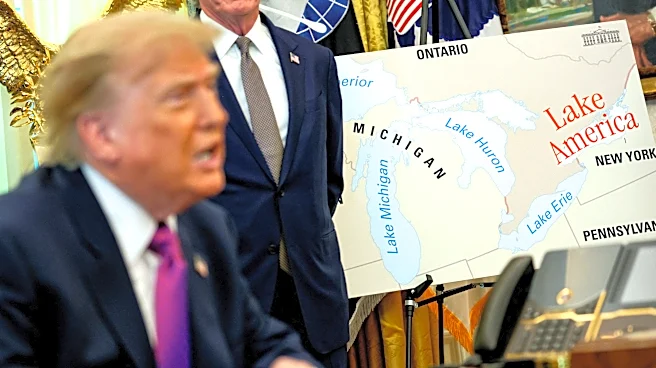
During an announcement by the Trump administration regarding drug price reductions in the Oval Office, an unusual interaction occurred between Dr. Mehmet Oz and Robert F. Kennedy Jr. As President Trump was signing an executive order, Robert F. Kennedy Jr.,
the U.S. health secretary, concluded his remarks and attempted to return to his position directly behind the President. However, Dr. Oz, the Medicare and Medicaid administrator, interjected with his own comments. While speaking, Dr. Oz was observed placing a hand on Kennedy Jr. twice, seemingly to keep him positioned to his left and prevent him from moving behind President Trump. Kennedy Jr. was only able to take his intended spot after Dr. Oz finished speaking and moved back to his own position. The two were briefly seen conversing afterward. This incident has drawn considerable attention and commentary online, with various political commentators and social media users highlighting the perceived awkwardness and tension of the moment.
Why It's Important?
This incident, while seemingly minor, highlights the dynamics and potential rivalries within the Trump administration and among figures associated with it. The public display of what appeared to be an attempt to control proximity to President Trump during a high-profile event can be interpreted in several ways. It could suggest a competition for influence or visibility among key officials and allies. Such moments, even if not directly related to policy, can shape public perception of the administration's internal cohesion and the relationships between its members. For political observers, it offers a glimpse into the informal hierarchies and personal interactions that often underpin political operations. The online reaction further amplifies the event, turning a brief interaction into a subject of broader political discussion and speculation about individual ambitions and allegiances within the political sphere.
What's Next?
While this specific incident is unlikely to have direct policy implications, it may contribute to ongoing narratives about the personalities and power struggles within President Trump's orbit. The White House and the Department of Health and Human Services have been approached for comment, and any official statements could either downplay the event or offer an alternative explanation. Social media and political commentators will likely continue to analyze and discuss the interaction, potentially using it as fodder for broader critiques or observations about political behavior. Future public appearances involving Dr. Oz, Robert F. Kennedy Jr., and President Trump may be scrutinized more closely for any signs of lingering tension or altered dynamics. The event could also influence how these individuals are perceived by the public and by their political peers, potentially affecting their standing or future political endeavors.
Beyond the Headlines
The incident transcends a simple awkward moment, touching upon the performative aspects of political power and proximity. In political optics, standing directly behind a leader during significant announcements often signifies trust, importance, and closeness. The perceived blocking of Robert F. Kennedy Jr. by Dr. Oz could be interpreted as a subtle but public assertion of status or an attempt to control the visual narrative of who stands closest to President Trump. This kind of non-verbal communication in high-stakes political environments can be as impactful as spoken words, conveying messages about hierarchy and influence to both internal and external audiences. It underscores how even seemingly trivial interactions are often imbued with deeper political meaning and can become subjects of intense scrutiny in the media landscape, reflecting broader themes of ambition, loyalty, and the constant jockeying for position within political circles.