





What's Happening?
Global trends in policy support for forcibly displaced populations are showing gradual progress, according to the Dataset of World Refugee and Asylum Policies (DWRAP). This dataset indicates a steady worldwide shift towards more inclusive policies across
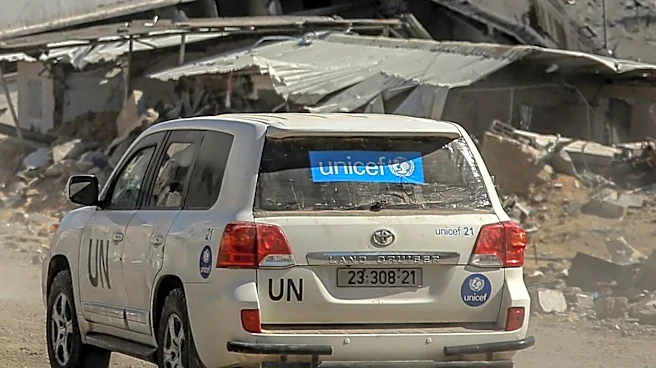
five key dimensions: access to legal status, provision of public welfare services, rights to work and property ownership (livelihoods), freedom of movement, and pathways to citizenship and political rights (participation). While challenges persist, regions like Europe and Latin America have demonstrated significant advancements in these areas. The number of forcibly displaced individuals reached a peak of 123 million in 2024, with 117.8 million remaining displaced at the end of 2025. This slight decline was attributed to large returns to Syria and Afghanistan, though new conflicts and climate change risks are expected to resume the upward trend. The United Nations Refugee Agency (UNHCR) has set a target to help 50% of refugees in long-term displacement in low- and middle-income countries achieve self-reliance by 2035.
Why It's Important?
The global shift towards more inclusive policies for forcibly displaced populations has significant implications for international humanitarian efforts and the stability of host communities. By promoting policies that grant displaced individuals access to markets, work rights, and integration into national social protection systems, the potential for economic self-reliance increases. This approach moves beyond a purely humanitarian model, aiming to foster long-term sustainability and reduce dependency on aid. For the U.S., these global trends highlight the evolving landscape of international migration and the potential for both collaboration and challenges in managing displaced populations. The success of inclusive policies in other regions could offer models for U.S. policy considerations, particularly as the country grapples with its own immigration and asylum challenges. Conversely, continued global displacement due to conflict and climate change could increase pressure on international resources and potentially impact U.S. foreign policy and aid commitments.
What's Next?
The United Nations Refugee Agency's target to achieve self-reliance for 50% of refugees in long-term displacement by 2035 will drive future policy development and program implementation. This goal necessitates a clear definition of self-reliance and the rapid generation of evidence regarding effective programs. Future research will likely focus on evaluating the effects of policies aimed at supporting forced migrants and their host communities, with a particular emphasis on quantitative studies employing quasi-experimental or experimental methods. The ongoing emergence of new conflicts and the escalating risks posed by climate change suggest that the number of forcibly displaced individuals is likely to resume its upward trend, requiring continuous adaptation and innovation in international and national migration policies. Governments and international organizations will need to continue assessing human rights risks, ensuring transparency, and fostering democratic scrutiny in migration management cooperation.
Beyond the Headlines
The move towards economic self-reliance for forcibly displaced populations represents a fundamental shift in how the international community addresses humanitarian crises. This approach acknowledges the inherent dignity and potential contributions of displaced individuals, moving beyond a narrative of victimhood to one of empowerment. The ethical implications of this shift are profound, as it challenges traditional aid models and emphasizes the importance of human rights, including the right to work and participate in society. Legally, this trend could lead to the re-evaluation and strengthening of international frameworks governing refugee and asylum policies, pushing for greater consistency and inclusivity across nations. Culturally, successful integration of displaced populations into host communities, facilitated by these inclusive policies, could foster greater understanding and reduce xenophobia, ultimately contributing to more resilient and diverse societies globally.