



What's Happening?
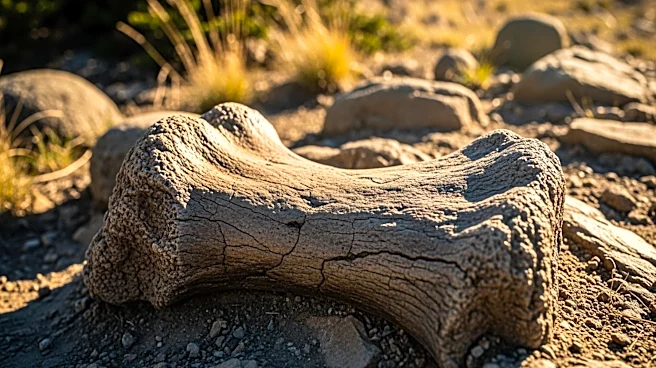
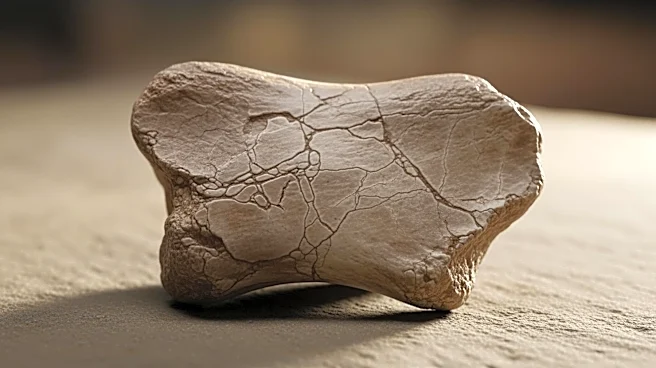
Researchers from the University of Liverpool have made a groundbreaking discovery by identifying traces of original organic molecules, including collagen, in dinosaur bones that are approximately 66 million years old. The study focused on a well-preserved
Edmontosaurus fossil, a duck-billed dinosaur, found in South Dakota's Hell Creek Formation. Using advanced laboratory techniques such as protein sequencing and mass spectrometry, the team detected remnants of collagen within the fossilized bone. This finding challenges the long-held belief that dinosaur fossils are merely mineralized rock devoid of any original biological material. The presence of hydroxyproline, an amino acid associated with collagen, further supports the authenticity of the discovery. This research, published in Analytical Chemistry, refutes the hypothesis that any organics found in fossils are due to contamination, reigniting a debate that has divided paleontologists for decades.
Why It's Important?
The discovery of preserved proteins in dinosaur fossils could revolutionize the study of extinct species. If proteins can survive for millions of years, they may provide new insights into the evolutionary relationships, physiology, and diseases of dinosaurs, which are not discernible from bones alone. This could lead to a deeper understanding of dinosaur biology and evolution. Additionally, the findings suggest that previously collected fossil samples might contain overlooked evidence of preserved collagen, offering a new avenue for research. The study also raises questions about the conditions that allow such molecules to survive over geological timescales, potentially leading to new scientific inquiries into fossil preservation processes.
What's Next?
The research team suggests that scientists may need to re-examine fossil samples collected over the past century for overlooked evidence of preserved proteins. This could involve revisiting cross-polarized light microscopy images taken decades ago, which might reveal intact patches of bone collagen. Such efforts could unlock new insights into dinosaur species and their evolutionary connections. Furthermore, understanding the conditions that allow for the preservation of organic molecules in fossils could lead to advancements in paleontological methods and techniques, potentially transforming the field.
Beyond the Headlines
The discovery of organic molecules in dinosaur fossils not only challenges existing scientific paradigms but also opens up ethical and philosophical questions about the nature of life and its preservation over time. It prompts a reevaluation of how we understand the fossilization process and the potential for discovering new forms of ancient life. This could have implications for other fields, such as astrobiology, where the preservation of biological materials over long periods is a key consideration in the search for extraterrestrial life.