


What's Happening?
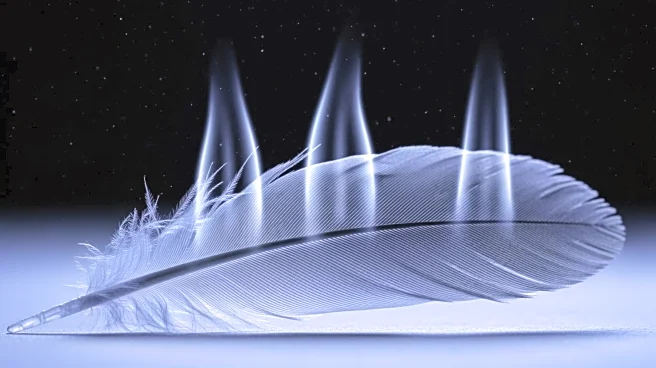
A recent study published in the journal Integrative Organismal Biology has, for the first time, measured how birds emit heat into space through mid-infrared radiation. This groundbreaking research was conducted by a team of material engineers and museum
biologists who explored the thermal properties of bird feathers. The study focused on five bird species, including the great horned owl and Northern bobwhite, across various regions in North America. The findings revealed that bobwhites, which inhabit open prairies and grasslands, showed significant variation in heat emittance. This suggests that exposure to open skies may influence how birds manage thermal loads. The research utilized advanced spectrometers to measure both near- and mid-infrared reflectances, providing new insights into how birds might adapt to rising global temperatures.
Why It's Important?
This study is significant as it enhances understanding of how birds adapt to climate change, particularly in terms of thermal regulation. The ability of birds to emit heat into space could inform the development of bioinspired materials designed for passive cooling. As global temperatures rise, understanding these natural adaptations becomes crucial for conservation efforts. The research highlights the potential for interdisciplinary collaboration to uncover nature's optimized solutions, which could be applied to human-engineered systems. Additionally, the study's findings may help predict how bird populations will cope with environmental changes, aiding in the development of strategies to protect vulnerable species.
What's Next?
Future research is expected to delve deeper into the microscopic mechanisms of how bird feathers manage heat. This could lead to breakthroughs in material science, particularly in creating materials that mimic these natural thermal properties. The study opens avenues for further interdisciplinary research, combining biology and engineering to explore bioinspired designs. Conservationists and policymakers may also use these findings to develop strategies that support bird populations in adapting to climate change. Continued exploration of these thermal adaptations could provide valuable insights into the resilience of various species in the face of environmental challenges.
Beyond the Headlines
The study's implications extend beyond immediate conservation efforts, potentially influencing the fields of thermal engineering and material science. By understanding how birds naturally manage heat, engineers can develop new technologies that improve energy efficiency and reduce reliance on artificial cooling systems. This research also underscores the importance of preserving natural habitats, as the thermal adaptations observed are closely linked to the birds' environments. The findings may prompt a reevaluation of how human activities impact these ecosystems and the species that inhabit them.