



What's Happening?
Alabama State University (ASU) has announced a comprehensive 'Master Plan' detailing significant upgrades and developments for its campus. University President Dr. Quinton Ross described this initiative as one of the most impactful events in the institution's
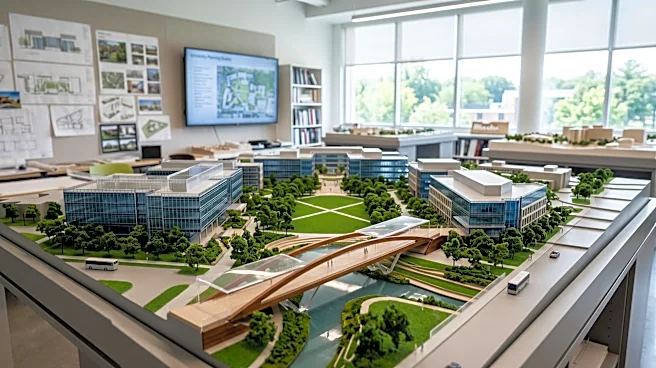
history. The plan, revealed on Thursday, includes visual renderings of proposed changes. Key elements of the master plan involve a complete redesign of the Harris Way Bridge over Interstate 85, extensive renovations to the campus quad, and development of the land surrounding the Interpretive Center. Additionally, the plan outlines major upgrades to existing facilities, with one rendering suggesting the potential construction of an indoor athletic practice facility. Donald Dotson, ASU's vice president of facilities management and operations, stated that the plan aims to integrate the university more closely with the community while expanding its academic and physical offerings over the next 15 to 20 years. The vision also includes the creation of state-of-the-art research spaces, technology-rich classrooms, and a central Student Success Center.
Why It's Important?
This 'Master Plan' signifies a substantial investment in Alabama State University's future, aiming to enhance its academic and athletic infrastructure. The proposed upgrades, particularly the state-of-the-art research spaces and technology-rich classrooms, could significantly improve the learning environment and attract a broader range of students and faculty. Modernized facilities often contribute to increased student enrollment and retention, bolstering the university's competitive standing among higher education institutions. The development of an indoor athletic practice facility could elevate ASU's sports programs, potentially attracting top athletic talent and increasing the university's visibility in collegiate sports. Furthermore, the plan's emphasis on opening the university to the community suggests a strategic effort to foster stronger local ties, which could lead to increased community engagement, partnerships, and support for ASU's initiatives. This long-term vision is crucial for the university's growth and its role as a key educational and cultural institution in Montgomery, Alabama.
What's Next?
Following the announcement of the 'Master Plan,' Alabama State University will likely proceed with detailed planning, fundraising efforts, and securing necessary approvals for the various projects. The university leadership, including President Dr. Quinton Ross and Vice President Donald Dotson, will focus on garnering support from stakeholders, including alumni, state officials, and potential donors, to fund the ambitious upgrades. The next steps will involve prioritizing specific projects within the plan, such as the Harris Way Bridge redesign or the development of new academic facilities, and initiating architectural and engineering phases. Community engagement will also be crucial as the university aims to integrate its campus more with the surrounding area. Over the next 15 to 20 years, the implementation of this plan will unfold in phases, with visible changes expected to begin with initial construction projects and facility renovations. The university will likely provide updates on progress and milestones as the plan moves forward.
Beyond the Headlines
The 'Master Plan' at Alabama State University represents more than just physical renovations; it embodies a strategic vision for institutional advancement and community integration. By investing in modern research facilities and technology-rich classrooms, ASU is positioning itself to address future educational demands and contribute more significantly to regional innovation and economic development. The emphasis on opening the campus to the community suggests a broader commitment to civic engagement and accessibility, potentially transforming the university into a more central hub for local activities and partnerships. This long-term planning also reflects a proactive approach to maintaining relevance and competitiveness in a rapidly evolving higher education landscape. The success of this plan could serve as a model for other historically Black colleges and universities (HBCUs) looking to modernize their infrastructure and expand their impact, highlighting the importance of strategic vision and investment in fostering institutional growth and community benefit.