
What's Happening?
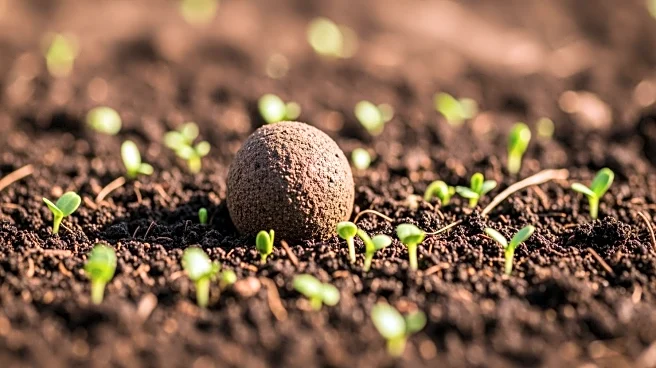
Researchers from INTA and Conicet have developed Biopellet, a pelletized biofertilizer designed to promote regenerative agriculture. This innovation is made from local compost and operates under a circular
economy model, offering a practical and economical solution to improve soil fertility. Biopellet has been validated in field trials with various crops, including tomatoes, vines, and vegetables, demonstrating its ability to enhance soil structure, nutrient availability, and crop productivity. The pelletized format facilitates transport, storage, and application, ensuring homogeneous distribution in the field. This development not only addresses soil fertility challenges but also turns agro-industrial waste into a strategic input, promoting the circular economy and generating local employment.
Why It's Important?
Biopellet represents a significant advancement in sustainable agriculture, providing an alternative to chemical fertilizers and raw manure. By improving soil fertility and promoting the circular economy, it offers environmental, social, and economic benefits. The innovation supports local producers by enhancing competitiveness and creating jobs, while also contributing to environmental sustainability. The potential for immediate adoption and scalability makes Biopellet a key tool for advancing regenerative agriculture, which is crucial for addressing global food security and environmental challenges. This development highlights the role of scientific research in providing practical solutions that strengthen the agriculture of the future.
What's Next?
The project aims to scale up production through a high-capacity plant capable of supplying local, regional, and international markets. INTA estimates that the initial market for Biopellet in Cuyo covers over 345,000 hectares, indicating significant adoption potential. As production scales, the focus will likely be on expanding market reach and enhancing the product's impact on sustainable agriculture. Stakeholders, including agricultural producers and environmental organizations, will be interested in the scalability and effectiveness of Biopellet in various agricultural settings. Continued research and development may lead to further innovations in biofertilizers, contributing to the broader goal of sustainable and regenerative agriculture.