



What's Happening?
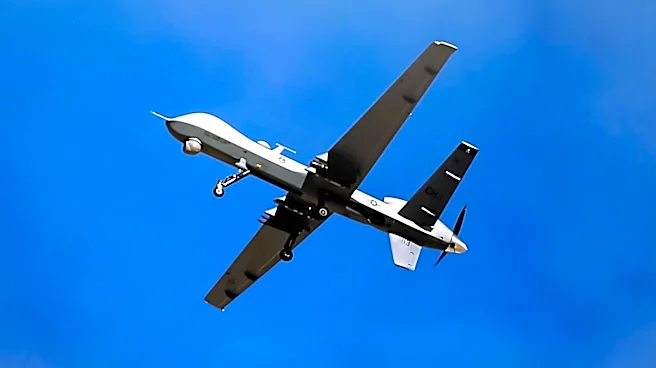
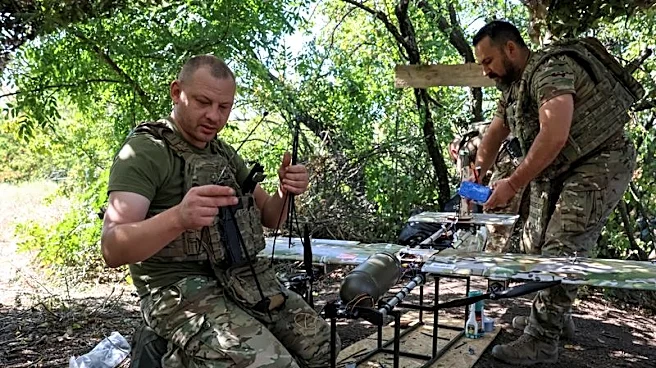
French President Emmanuel Macron has directed his government to develop a plan for protecting critical infrastructure, including sensitive defense industry sites, against drone and cyberattacks. This directive comes in response to what Macron described
as an intensifying Russian hybrid threat targeting Europeans and France. Speaking at the Elysee Palace after a meeting with political party leaders, President Macron specifically cited drone attacks and cyberattacks as key components of this threat. The European Union defines Russian hybrid activities as encompassing sabotage, cyberattacks, disinformation, and interference in democratic processes. President Macron warned that these attacks would not go unanswered and accused Moscow of attempting to intimidate Europeans into weakening their support for Ukraine, emphasizing that Europe's present and future security is at stake in Ukraine.
Why It's Important?
President Macron's order to bolster infrastructure protection highlights a significant escalation in perceived threats from Russia, extending beyond traditional military confrontation to encompass hybrid warfare tactics. This development is crucial for U.S. and European security, as it underscores the interconnectedness of national infrastructures and the potential for cyber and drone attacks to disrupt essential services and defense capabilities. The focus on protecting defense industry sites suggests concerns about maintaining military readiness and technological advantage. The accusation that Russia is attempting to undermine European support for Ukraine through these tactics indicates a broader geopolitical struggle, where information warfare and critical infrastructure vulnerabilities are being exploited. This situation could lead to increased cybersecurity investments, enhanced intelligence sharing among NATO allies, and a re-evaluation of defense strategies to counter these evolving threats, impacting U.S. foreign policy and defense spending.
What's Next?
Following President Macron's directive, the French government will proceed with developing and implementing the infrastructure protection plan. This will likely involve increased investment in cybersecurity measures, drone detection and defense systems, and enhanced intelligence capabilities. President Macron also announced his intention to convene a Group of Seven (G7) meeting in the coming weeks to coordinate a response to the energy crisis, which he linked to conflicts in the Middle East and Ukraine, as well as disruptions in the Strait of Hormuz. This G7 meeting will likely address the broader implications of the Russian hybrid threat and its impact on global energy markets and economic stability. The coordinated response among G7 nations could include joint cybersecurity initiatives, economic sanctions, and diplomatic efforts to de-escalate tensions. The situation will also likely prompt other European nations and the U.S. to review and strengthen their own critical infrastructure defenses.
Beyond the Headlines
The escalating hybrid threat described by President Macron points to a fundamental shift in modern warfare, where the lines between conventional conflict and covert operations are increasingly blurred. This has profound implications for international law, the concept of national sovereignty, and the ethical considerations surrounding state-sponsored cyberattacks and disinformation campaigns. The targeting of critical infrastructure, such as defense industries, raises concerns about the potential for widespread societal disruption and the erosion of public trust in government institutions. Furthermore, the link drawn between the energy crisis and geopolitical conflicts highlights the vulnerability of global supply chains and the strategic importance of energy security. This situation could accelerate the transition to renewable energy sources and foster greater energy independence among European nations, potentially reshaping global energy markets and geopolitical alliances in the long term. The emphasis on countering disinformation also underscores the ongoing battle for narrative control in the digital age.