

What's Happening?
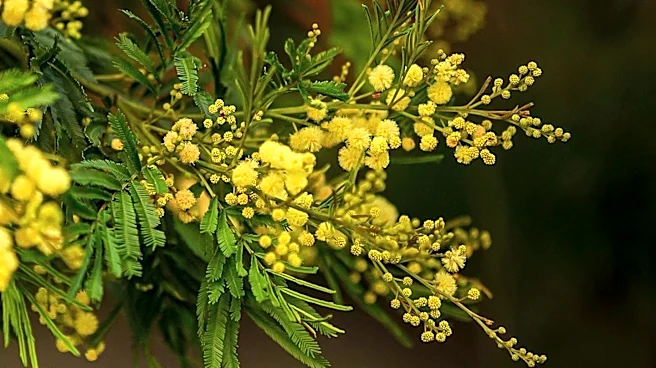
The mimosa tree (Albizia julibrissin), introduced to the United States around 1745 for its fragrant pink flowers and delicate foliage, has escaped cultivation and is now considered an invasive species across parts of the southern and eastern U.S. Initially
welcomed as an ornamental, the tree's ability to grow quickly, produce numerous seeds, and resprout after being cut has allowed it to establish itself along roadsides, clearings, flood plains, and other disturbed areas. Its long, flat seed pods, containing several seeds, can be dispersed by wind and water, further aiding its spread. In areas where mimosa forms dense stands, it competes with native trees and shrubs, altering habitat along forest edges and waterways. The Maryland Invasive Species Council notes that mimosa can invade riparian areas, old fields, and roadsides, with its seeds remaining dormant for years due to their hard, impermeable coats, making control difficult.
Why It's Important?
The widespread invasion of mimosa trees poses a significant ecological challenge to native ecosystems across the U.S. South and East. Its aggressive growth and reproductive capabilities displace native flora, disrupting local biodiversity and altering natural habitats. This ecological imbalance can have cascading effects on wildlife that depend on native plants for food and shelter. For landowners and land managers, controlling mimosa requires substantial effort and resources, as mechanical removal alone is often insufficient due to the tree's ability to resprout and its long-lived dormant seeds. The situation highlights the long-term consequences of introducing non-native species, even those initially perceived as beneficial, and underscores the importance of careful consideration in landscaping choices to prevent future ecological problems. The economic impact includes costs associated with removal and restoration of affected areas.
What's Next?
Efforts to manage and control the spread of mimosa trees will likely continue to focus on a combination of methods. Young seedlings can be removed manually, while larger trees often require cutting followed by additional treatments to prevent resprouting. The Maryland Invasive Species Council recommends preventing seed production and utilizing mechanical removal, girdling, and carefully applied herbicide treatments. There are currently no known biological control agents for mimosa. Extension services are increasingly recommending native alternatives, such as serviceberry, flowering dogwood, and eastern redbud, for landscapes where an ornamental small tree is desired. Public awareness campaigns may also be implemented to educate homeowners and gardeners about the risks of planting invasive species and to promote native plant alternatives to mitigate further spread.
Beyond the Headlines
The story of the mimosa tree serves as a cautionary tale regarding the unintended consequences of human intervention in natural environments. It illustrates how aesthetic preferences can inadvertently lead to significant ecological damage over time. This case also brings to light the ethical considerations involved in introducing non-native species and the responsibility to understand their potential long-term impacts. The ongoing struggle to control mimosa reflects a broader challenge in conservation: balancing human desires for ornamental beauty with the preservation of native ecosystems. It also highlights the need for robust scientific assessment before introducing new species and for adaptive management strategies when invasive species become established, emphasizing the dynamic and often unpredictable nature of ecological systems.