

What's Happening?
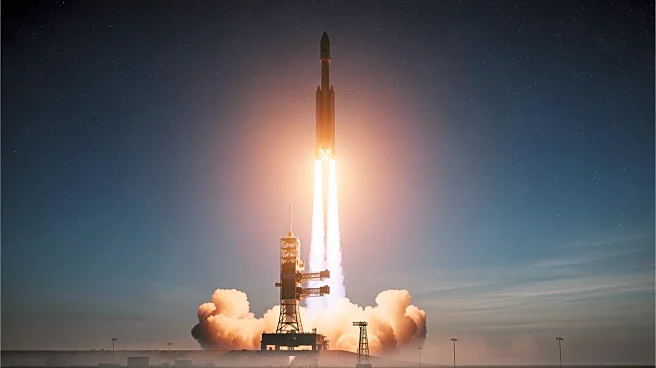
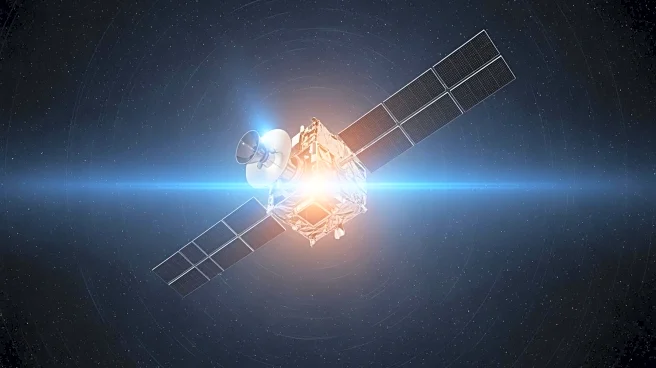
The Cosmic Background Explorer (COBE) satellite, launched by NASA on November 18, 1989, has significantly advanced the field of precision cosmology. Developed by a team at NASA's Goddard Space Flight Center, Ball Aerospace, the Jet Propulsion Laboratory,
and various universities, COBE was designed to study the cosmic microwave and infrared background light from the distant universe. This mission has provided critical insights into the universe's expansion, often referred to as the Big Bang, although the term is considered a misnomer by some astronomers. The satellite's measurements of the cosmic microwave background radiation, with a precision of 50 parts per million, confirmed the predicted blackbody spectrum, a feat unmatched by any other cosmological theory. The discovery of anisotropy, or variations in the cosmic heat radiation, was hailed by Stephen Hawking as one of the most significant scientific discoveries of the century.
Why It's Important?
The findings from the COBE satellite have profound implications for our understanding of the universe. The detection of anisotropy in the cosmic microwave background radiation suggests that these variations are responsible for the formation of galaxies and other large-scale structures in the universe. The data indicates that gravity, acting on regions of higher density, halted the expansion of matter, leading to the formation of galaxies. Furthermore, the discovery that most of these variations are caused by dark matter opens new avenues for research into the nature of dark matter and its role in the universe. The success of the COBE mission has laid the groundwork for future space missions and has been instrumental in advancing the field of cosmology, earning its team, including John Mather and George Smoot, the Nobel Prize in Physics in 2006.
What's Next?
Following the success of the COBE mission, NASA and its partner agencies continue to explore the universe's mysteries through advanced space missions. The insights gained from COBE have paved the way for subsequent missions like the James Webb Space Telescope, which aims to further unravel the complexities of the universe. As technology advances, future missions will likely build on COBE's legacy, employing more sophisticated instruments to explore the universe's origins and the fundamental forces shaping it. The ongoing collaboration between scientists and engineers at NASA and other space agencies will continue to push the boundaries of what is possible in space exploration and cosmology.
Beyond the Headlines
The COBE mission highlights the intricate relationship between space science and engineering, showcasing how collaborative efforts can lead to groundbreaking discoveries. The mission's success underscores the importance of interdisciplinary collaboration in tackling complex scientific challenges. Additionally, the mission's findings have sparked discussions about the nature of the universe, the role of dark matter, and the potential for understanding quantum gravity. These discussions have broader implications for our understanding of the universe and our place within it, influencing philosophical and scientific perspectives on the nature of existence.