





What's Happening?
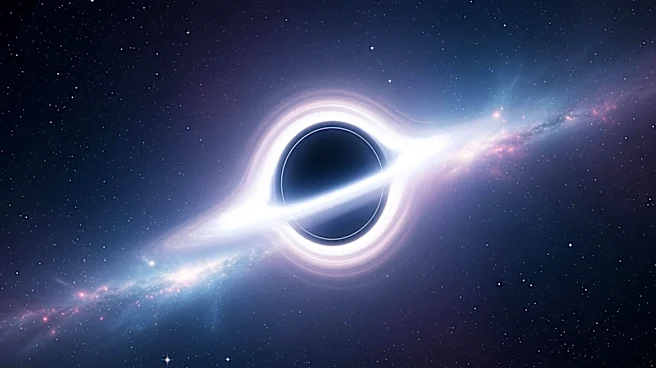
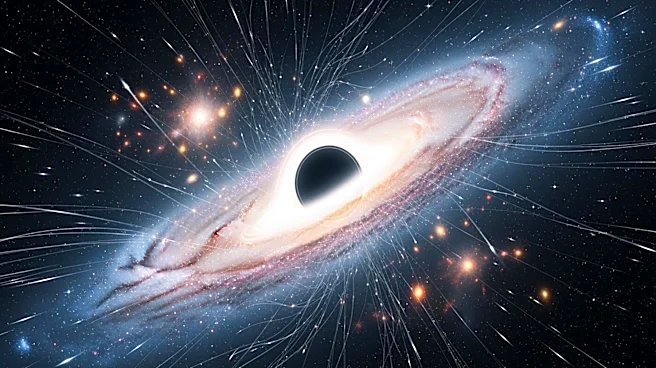
Recent simulations have explored the possibility that primordial black holes (PBH) could be a component of dark matter. These black holes, theorized to have formed in the early universe, might be captured by stars, leading to two potential outcomes: rapid
destruction of the star or gradual consumption by the PBH. The research, led by Ore Gottlieb from MIT, suggests that PBHs could range in size from asteroid to lunar size, and their capture by stars could provide insights into their contribution to dark matter. The study highlights the importance of understanding the mass and capture dynamics of PBHs, which could significantly impact the evolution of stars and the formation of gravitational waves.
Why It's Important?
The study of primordial black holes as a component of dark matter is crucial for understanding the universe's composition and the behavior of stars. If PBHs are indeed a significant part of dark matter, their interactions with stars could lead to observable phenomena such as electromagnetic emissions and gravitational waves. This research could pave the way for new methods of detecting dark matter and understanding its role in cosmic evolution. The findings could also influence future astrophysical research and the development of technologies aimed at detecting these elusive objects.
What's Next?
Further research is needed to explore the capture dynamics of PBHs and their impact on stars. The study suggests that PBH capture is more likely in three-body systems, indicating a need for more detailed simulations and observations. Future work could focus on identifying the electromagnetic and gravitational wave signatures of PBH interactions, which would help confirm their role in dark matter. Additionally, advancements in telescope technology and data analysis could enhance the detection of these phenomena, providing deeper insights into the universe's structure.
Beyond the Headlines
The implications of PBHs as dark matter extend beyond astrophysics, potentially influencing cosmology and particle physics. Understanding PBHs could shed light on the conditions of the early universe and the fundamental forces that shaped it. This research also raises ethical considerations regarding the allocation of resources for space exploration and the potential impact of new discoveries on our understanding of the universe.