







What's Happening?
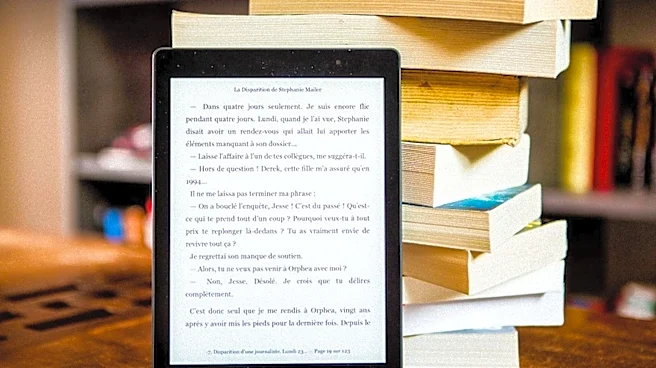
E-readers are mobile electronic devices specifically designed for reading digital e-books. Platforms like Rakuten Kobo categorize e-books into various genres, including Fiction & Literature, Romance, Nonfiction, Mystery & Suspense, Young Adult - YA, Kids,
Science Fiction & Fantasy, Biography & Memoir, Business & Finance, and Comics, Graphic Novels, & Manga. Kobo also facilitates pre-orders for upcoming releases such as "Threshing Day" by Rebecca Yarros and "A Court of Splintered Harmony" by Sarah J. Maas. Additionally, free Catholic e-books covering topics like Eucharist, Exorcism, Marian Apparitions, and Papal Encyclicals are accessible through Maryourhelp.org. For children, free e-books available on Amazon Kindle include titles like "When Will I Get Bigger?" by C.S. Duval and "Mr. Flopsy, Little Hops of Light" by Christi Eley, catering to a wide range of interests and age groups.
Why It's Important?
The widespread availability and diverse categorization of e-books across multiple platforms signify a significant shift in content consumption and accessibility within the U.S. This trend impacts various sectors, from publishing and education to religious organizations and individual consumers. For the publishing industry, the digital format allows for broader distribution and new revenue models, while also creating opportunities for independent authors. Educational institutions and libraries benefit from the ease of access to a vast array of resources, potentially lowering costs and expanding learning opportunities. Religious organizations can disseminate their teachings and texts more widely, reaching a larger audience. Consumers, in turn, gain unprecedented access to literature, educational materials, and specialized content, often at reduced costs or for free, fostering a more informed and engaged populace. The ease of access to diverse genres, from popular fiction to specialized religious texts and children's literature, underscores the transformative power of e-books in democratizing information and entertainment.
What's Next?
The continued evolution of e-book platforms is expected to further enhance user experience and content accessibility. This may include more sophisticated recommendation engines, improved integration with educational and professional tools, and expanded support for interactive and multimedia elements within e-books. Publishers will likely continue to explore new digital-first publishing models and subscription services to cater to evolving consumer preferences. The trend of offering free e-books, particularly in niche categories like religious texts or children's literature, is also likely to grow, driven by organizations seeking to expand their reach and impact. Technology developers will focus on improving e-reader hardware and software, making devices more intuitive, durable, and feature-rich. Furthermore, the increasing adoption of e-books could lead to new discussions around digital rights management, intellectual property, and equitable access to digital content for all demographics.
Beyond the Headlines
The proliferation of e-books extends beyond mere convenience, touching upon deeper societal and cultural implications. The digital format challenges traditional notions of physical ownership and the role of libraries as physical repositories of knowledge, shifting towards digital archives and lending models. The ability to access a vast library of content on a single device can influence reading habits, potentially encouraging more diverse reading and fostering a culture of continuous learning. Ethical considerations arise concerning data privacy, as platforms collect user reading data, and the potential for digital divides if access to technology remains unequal. Moreover, the environmental impact of digital publishing, while reducing paper consumption, introduces new concerns related to electronic waste and energy consumption from data centers. The long-term cultural impact on literacy, critical thinking, and the preservation of diverse literary voices in a predominantly digital landscape remains a subject of ongoing discussion and adaptation.