
What's Happening?
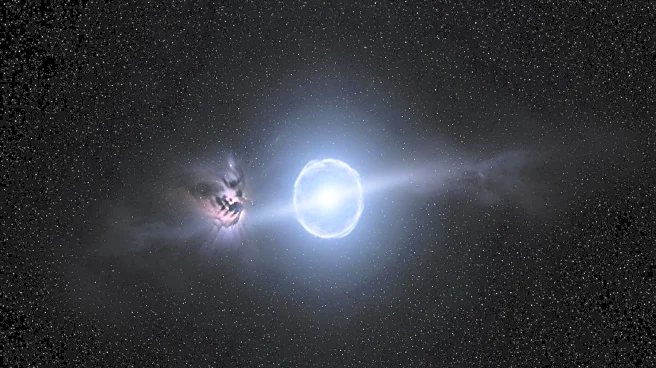
Recent findings from the James Webb Space Telescope have identified three unusual objects that may be 'dark stars', a concept that could redefine our understanding of the universe's early history. Unlike typical stars, dark stars are theorized to emit
light not from nuclear fusion but from energy released by dark matter. This discovery revives the hypothesis that dark matter, which constitutes about 27% of the universe, could have played an active role in star formation after the Big Bang. The objects observed are much brighter and possibly more massive than early stars or galaxies, suggesting they could be the earliest evidence of dark stars. These stars are believed to be extremely large, composed mainly of hydrogen and helium, and exhibit a strong redshift due to the universe's expansion.
Why It's Important?
The potential discovery of dark stars could significantly alter the current astrophysical models of star formation and the role of dark matter in the universe. If confirmed, these findings suggest that dark matter was not merely a passive element but actively contributed to the formation of the first stars. This could lead to a paradigm shift in how scientists understand the early universe and the processes that led to the formation of galaxies. The implications extend to the broader field of cosmology, potentially affecting theories about the universe's evolution and the nature of dark matter itself. The discovery challenges existing models and underscores the need for further research and observation to validate these findings.
What's Next?
Further observations and theoretical developments are necessary to confirm the existence of dark stars. Scientists will likely focus on gathering more data from the James Webb Space Telescope and other observational tools to distinguish these objects from massive normal stars or unusual galaxies. The scientific community may also develop new models to better understand the role of dark matter in star formation. As research progresses, these efforts could lead to a deeper understanding of the universe's early history and the fundamental forces shaping it. The debate within the scientific community is expected to continue, with some researchers skeptical about the dark star hypothesis, emphasizing the need for more conclusive evidence.
Beyond the Headlines
The concept of dark stars introduces intriguing questions about the nature of dark matter and its interactions with normal matter. If dark stars are confirmed, they could provide insights into the properties of dark matter particles, such as whether they are their own antiparticles. This could have broader implications for particle physics and our understanding of fundamental forces. Additionally, the study of dark stars could reveal new information about the conditions of the early universe, potentially influencing theories about cosmic inflation and the formation of large-scale structures. The exploration of dark stars may also inspire new technological advancements in telescope design and data analysis techniques.