



What's Happening?
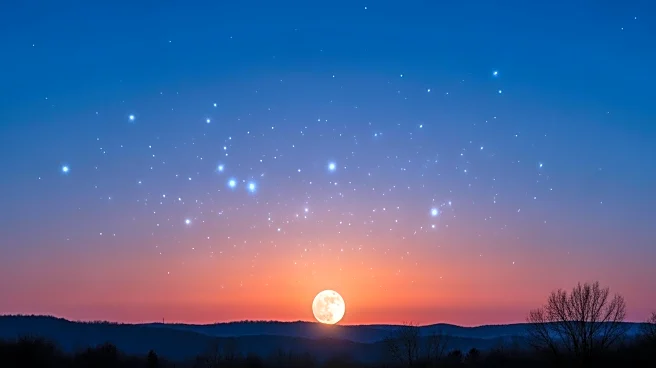
Tonight, stargazers in the U.S. will have the opportunity to witness the full 'Snow Moon' as it rises in the eastern sky at sunset. This celestial event occurs when the moon reaches 100% illumination, appearing opposite the sun in the sky. The 'Snow Moon' is named
for the heavy snowfall typically associated with February. As it rises, the moon may appear yellow-orange due to Rayleigh Scattering, a process where Earth's atmosphere deflects blue wavelengths of moonlight, allowing red wavelengths to pass through. This full moon is also a chance to observe 'ejecta rays' on the lunar surface, which are bright streaks of reflective material cast out during crater-forming events. The Tycho crater, near the south lunar pole, is particularly noted for its impressive ejecta rays.
Why It's Important?
The full 'Snow Moon' provides a unique opportunity for both amateur and professional astronomers to observe and study lunar features. The visibility of ejecta rays during this time offers insights into the moon's geological history and the impact events that have shaped its surface. Additionally, the event encourages public interest in astronomy and space science, fostering educational opportunities and inspiring future generations of scientists. The presence of Jupiter and other celestial bodies in proximity to the moon enhances the stargazing experience, making it a significant event for skywatchers.
What's Next?
Following the 'Snow Moon', astronomers and enthusiasts can look forward to other celestial events throughout the year, including meteor showers and planetary alignments. These events continue to provide opportunities for public engagement and education in astronomy. The study of lunar features during full moons contributes to ongoing research in planetary science, aiding in the understanding of similar processes on other celestial bodies.
Beyond the Headlines
The cultural significance of the 'Snow Moon' is reflected in its various names, such as the 'Bear Moon' and 'Hunger Moon', which highlight historical and seasonal associations. These names offer a glimpse into how different cultures have historically related to and interpreted celestial events. The continued fascination with the moon and its phases underscores humanity's enduring connection to the night sky and its mysteries.