







What's Happening?
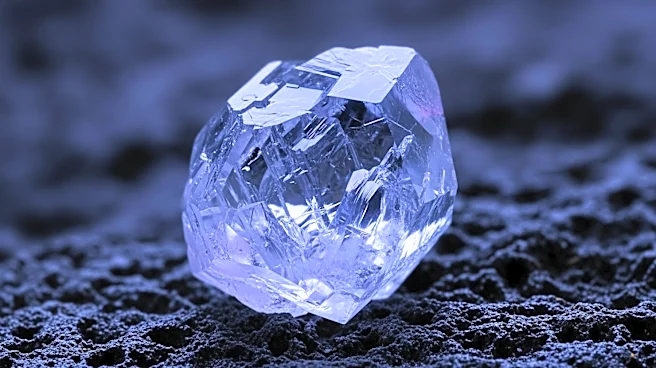
Eighty years after the Trinity nuclear test, scientists have identified a new crystal compound formed during the explosion. The discovery was made in red trinitite, a glassy material created by the extreme conditions of the nuclear detonation. Researchers
found a clathrate compound, a type of crystal that traps molecules within its structure, in a copper-rich metal droplet. This finding, published in the Proceedings of the National Academy of Sciences, provides new insights into the materials produced under the extreme conditions of nuclear explosions.
Why It's Important?
The discovery of a new crystal compound in the remnants of the Trinity nuclear test has significant implications for materials science and our understanding of high-energy events. It highlights the unique conditions under which new materials can form, offering potential applications in various scientific fields. This research could lead to advancements in synthesizing materials that are difficult to produce under normal laboratory conditions, expanding the possibilities for innovation in technology and industry.