


What's Happening?
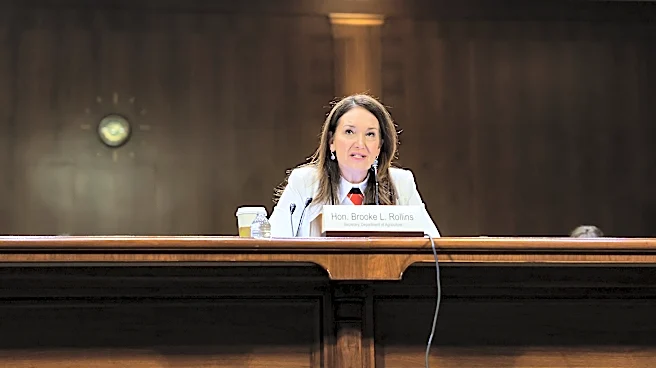
U.S. Secretary of Agriculture Brooke Rollins and U.S. Secretary of the Interior Doug Burgum have announced a proposed rule aimed at updating grazing permit issuance, eligibility, qualifications, and revising grazing fee provisions for ranchers. This rule applies
to those who graze livestock on national forests and grasslands across 16 contiguous Western states. The proposed rule, which began its 30-day public comment period, seeks to provide a more seamless practice for America’s ranchers and benefit rural communities by supporting both small and large ranching operations, potentially creating more local jobs. Secretary Rollins emphasized the administration's focus on cutting red tape to allow ranchers to continue their legacy of feeding America and maintaining healthy rangelands. The Forest Service currently permits livestock grazing on nearly 40 percent of its 193 million managed acres.
Why It's Important?
This proposed rule is significant for the U.S. agricultural sector, particularly for ranchers in the Western states. By streamlining grazing permit processes and standardizing fee provisions, the rule aims to reduce administrative burdens and provide greater operational certainty for ranchers. This could lead to increased efficiency and profitability for ranching operations, which are vital to the economic vitality of many rural communities. The alignment of USDA Forest Service practices with Bureau of Land Management (BLM) regulations is crucial for ranchers who utilize lands managed by both agencies, creating a more unified and less complex regulatory environment. Furthermore, managed grazing contributes to reducing dangerously dry vegetation, thereby lowering the risk of catastrophic wildfires, which is a significant environmental concern in Western states. The economic impact is substantial, with grazing on Forest Service lands contributing approximately 14,200 jobs and $645 million to the nation’s gross domestic product annually.
What's Next?
The proposed rule has entered a 30-day public comment period, during which stakeholders, including ranchers, environmental groups, and the general public, can submit their feedback. Following this period, the USDA and Department of the Interior will review the comments and may make revisions to the rule before its finalization. Once finalized, ranchers in the 16 Western states will experience updated procedures for obtaining and managing grazing permits, as well as revised fee structures. The goal is to implement a more consistent framework across federal lands, which could lead to a more predictable operating environment for the ranching industry. The administration will likely monitor the rule's impact on both ranching operations and rangeland health to assess its effectiveness.
Beyond the Headlines
Beyond the immediate regulatory changes, this proposed rule reflects a broader administrative philosophy of reducing perceived bureaucratic obstacles for key industries. It highlights the ongoing tension between economic development, particularly in traditional sectors like ranching, and environmental stewardship of public lands. The rule's emphasis on supporting ranchers as stewards of the land suggests a policy approach that views grazing as a tool for land management, including wildfire prevention. However, it also raises questions about the long-term ecological impacts of grazing practices and the balance between agricultural productivity and conservation goals. The alignment of regulations between different federal agencies could set a precedent for future inter-agency cooperation on land management issues, potentially leading to more integrated approaches to public land use across the U.S.