







What's Happening?
Researchers at the University of Illinois Urbana-Champaign have created a printable fabric capable of cooling the body, collecting energy from movement, and producing electrical signals. This innovative material could lead to the development of smart
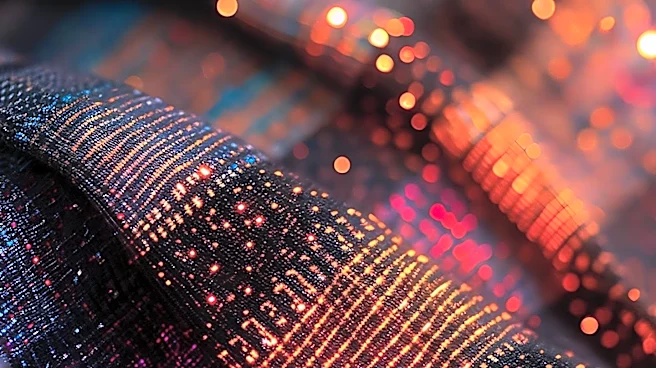
athletic clothing and other wearable products that adapt to a user's activity and temperature needs. Unlike many smart textiles that rely on multiple layers, this new material integrates several functionalities into a single printable component, making it potentially lighter, more comfortable, and easier to manufacture. The fabric employs passive radiative cooling, reflecting 96% of incoming sunlight and releasing body heat, allowing it to remain 3 to 6 degrees Celsius cooler than the ambient air during outdoor tests. This cooling mechanism operates without external power. Additionally, the textile can convert mechanical movement into electrical energy and signals, which could be used to detect activity levels and regulate other clothing functions, such as switching between cooling and heating. The material is produced using direct ink writing, a method similar to 3D printing, which allows for the creation of breathable and flexible textile structures.
Why It's Important?
This development holds significant implications for various U.S. industries, particularly in sports, outdoor recreation, and potentially military applications. The ability of a single fabric to provide cooling, harvest energy, and generate electrical signals could revolutionize wearable technology, offering enhanced comfort and functionality without the bulk or complexity of current multi-layered smart textiles. For athletes and outdoor workers, this could mean clothing that actively manages body temperature and provides power for small electronic devices, improving performance and safety. The energy-harvesting capability could reduce reliance on external power sources for wearable electronics, contributing to more sustainable and self-sufficient designs. Furthermore, the direct ink writing manufacturing method suggests a scalable and potentially cost-effective production process, which could accelerate the adoption of these advanced textiles in consumer markets. The integration of multiple functionalities into one material addresses current limitations in smart fabric design, paving the way for more integrated and efficient wearable solutions.
What's Next?
The technology is currently in the research phase, and further development is required before it can be widely adopted. Researchers will need to conduct extensive testing to assess the material's long-term durability, washability, cost-effectiveness, and performance under various everyday conditions. This will involve rigorous trials to ensure the fabric can withstand repeated use and cleaning cycles without degrading its smart functionalities. Future work will also focus on optimizing the energy harvesting efficiency and the precision of electrical signal generation to enable more sophisticated control over clothing features. Collaborations with textile manufacturers and apparel companies will be crucial to transition this laboratory innovation into commercially viable products. The potential for integration with existing smart home or health monitoring systems will also be explored, expanding the applications beyond simple temperature regulation to comprehensive personal environmental control.
Beyond the Headlines
The advancement in printable smart fabrics represents a broader shift towards intelligent and adaptive materials that blur the lines between clothing and technology. This innovation could lead to ethical considerations regarding data privacy if the electrical signals generated by movement are used to track personal activity or health metrics. On a societal level, widespread adoption of such textiles could influence fashion trends, promoting functional and sustainable clothing choices. Environmentally, reducing the need for external power sources in wearables aligns with broader sustainability goals, potentially decreasing battery waste and energy consumption. The ability to create multi-functional textiles from a single material also hints at a future where manufacturing processes are streamlined, potentially reducing the environmental footprint associated with complex multi-component products. This technology could also inspire new forms of human-computer interaction, where clothing itself becomes an interface for environmental control and personal data collection, leading to a more integrated and responsive personal ecosystem.