
What's Happening?
Mozambique's economy is currently facing significant pressure, prompting an International Monetary Fund (IMF) mission to visit the country for discussions on potential reforms. These discussions are aimed
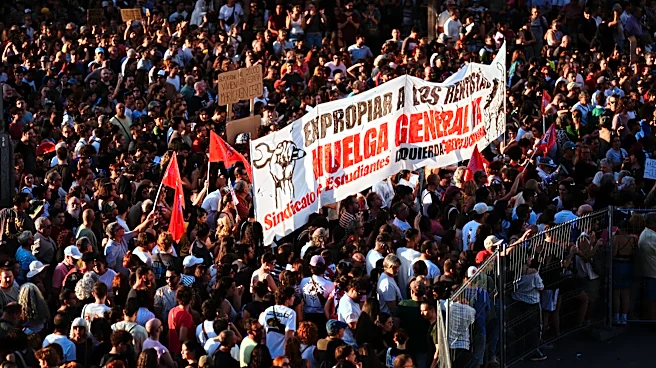
at paving the way for a fund-supported program. The IMF has indicated that Mozambique is grappling with substantial fiscal and external challenges, necessitating further reforms. This economic strain is occurring against a backdrop of political instability, including a disputed presidential election in 2024 that led to protests and political violence, and an ongoing Islamist insurgency in the northern part of the country. The European Union (EU) has also been involved in Mozambique, providing development and humanitarian assistance, and engaging in security operations, with a recent allocation of €24.5 million for humanitarian aid.
Why It's Important?
The IMF's involvement and the conditions tied to its financial aid are crucial for Mozambique's economic stability and could have broader implications for regional security and economic partnerships. The requirement for significant fiscal and external reforms suggests a need for fundamental changes in Mozambique's economic management, which could impact its ability to attract foreign investment and maintain trade relationships. For South Africa, Mozambique's stability is particularly important due to shared economic interests, such as the natural gas pipeline supplying South African industry and the Maputo Corridor, a vital trade route. Instability in Mozambique, as seen after the 2024 election, can disrupt these connections, affecting South African businesses and the flow of goods. Furthermore, political and economic turmoil in Mozambique can lead to increased migration across the border into South Africa, creating social and economic pressures.
What's Next?
Mozambique is expected to continue discussions with the IMF regarding the implementation of fiscal and external reforms to secure a fund-supported program. The outcome of these negotiations will likely dictate the country's economic trajectory in the short to medium term. Concurrently, the Mozambican government will need to address the ongoing political instability and the Islamist insurgency, which continue to pose significant challenges to national security and economic development. The international community, including the EU, may reconsider its funding strategies and conditions for assistance based on the country's progress in reforms and stability. The potential for continued political violence and economic hardship could also lead to further cross-border migration, impacting neighboring countries like South Africa.
Beyond the Headlines
The situation in Mozambique highlights the complex interplay between economic stability, political governance, and regional security. The IMF's conditional aid underscores a global trend where financial assistance is increasingly linked to policy reforms, potentially influencing the internal political and economic structures of recipient nations. The challenges faced by Mozambique, including electoral integrity issues and insurgencies, demonstrate how internal conflicts can have significant external ramifications, affecting trade, migration, and regional stability. This scenario also raises questions about the effectiveness of international aid and intervention in fostering long-term stability and good governance, particularly when faced with deep-seated political and social issues. The interconnectedness of economies and societies in Southern Africa means that Mozambique's struggles are not isolated, but rather part of a larger regional dynamic.